

POLLING | Anti-dirty AI: What Americans Think About Data Centers
Data centers appear to be facing growing public resistance in America, according to Heatmap Pro research. Public opinion coverage to date has often treated the reasons as static: people don’t want them nearby, they see data centers as natural resource drains, and they expect their bills to rise because of them.
A new national survey of 1,292 US adults, conducted by YouGov on behalf of EnergyTag, finds that this isn’t the full picture. Opposition remains significant, but opposition shifts sharply depending on how a data center is powered – and Americans have clear, consistent, and largely bipartisan standards for what counts as proving “clean.”
Key Findings
Opposition to data centers hasn’t gone away, but how they are powered changes opinions.
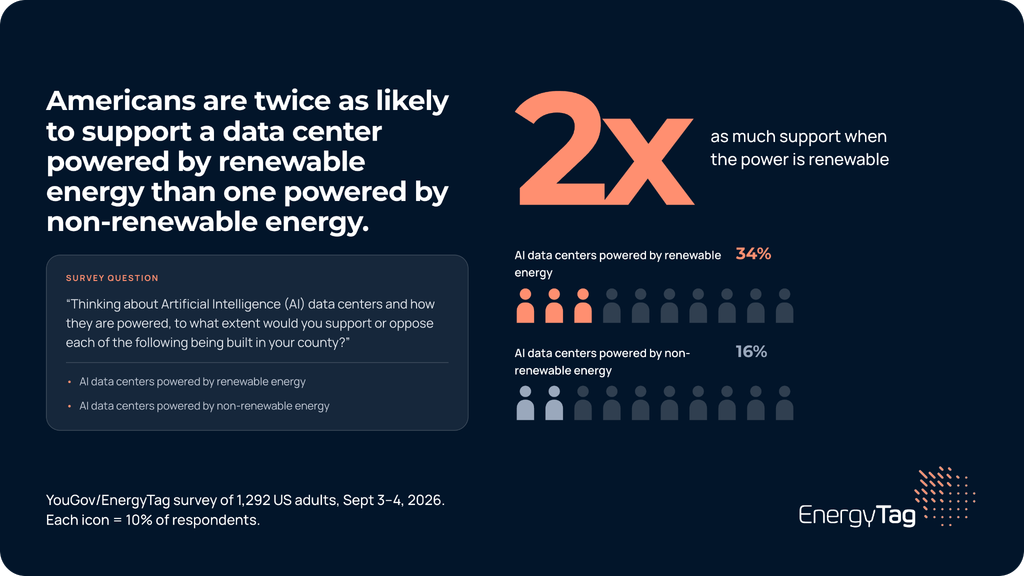
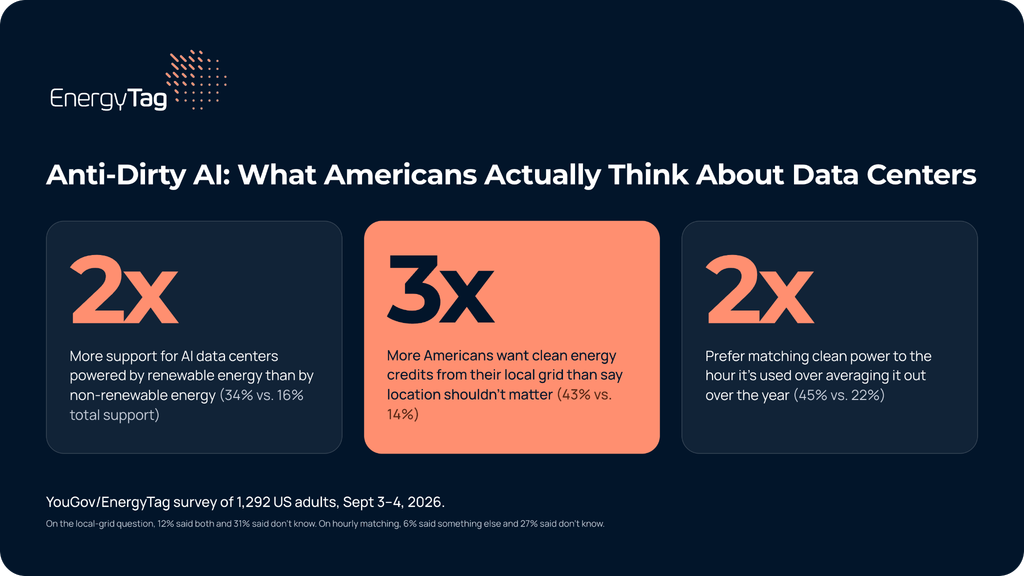
- Twice as many Americans support a data center powered by renewable energy as one powered by fossil fuels — 34% compared to 16%.
- Opposition follows the same pattern in reverse: 53% oppose a fossil-fueled data center, well above the 32% who oppose a renewable-powered one.
- Notably, among Trump 2024 voters, 40 percent supported data centers powered by renewable energy, compared to just 25 percent supporting data centers powered by nonrenewable sources.
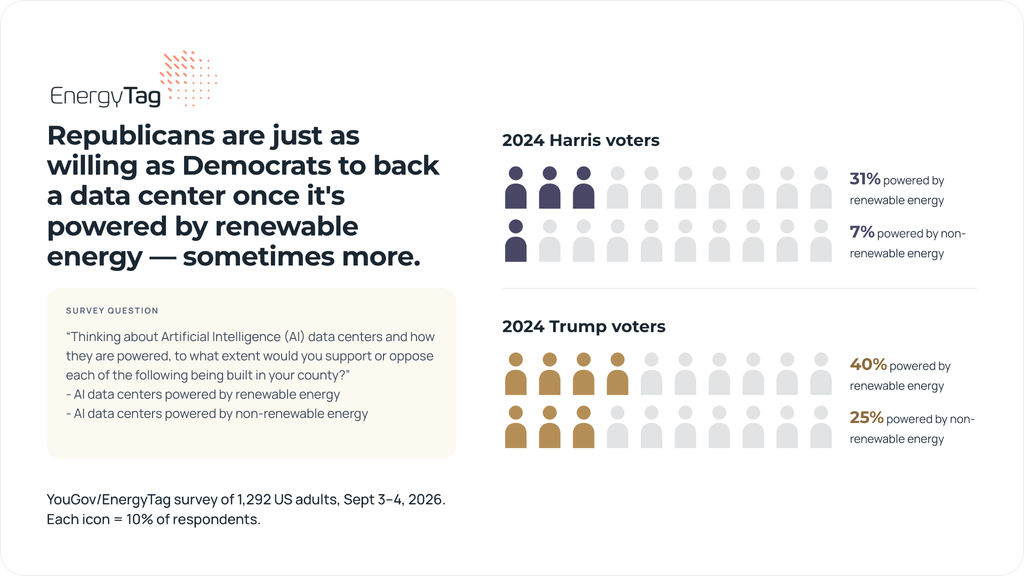
The Trump voter split is interesting. Support for a fossil-fueled data center splits sharply by party. Harris voters oppose one by 74% to Trump voters’ 42%, a 32-point gap. But specify renewable power, and that gap less than halves. Clean power moves Harris voters the most – their opposition drops by 34 points, versus 12 for Trump voters, even though Trump voters are more supportive overall.
Americans reject the industry’s current way of proving “clean.”
Powering a data center with clean energy garners more public support than those powered by fossil fuels. However, consumers’ and companies’ definitions of proving “clean energy” vary. Today, most companies prove it with annual credits, often bought from a different region entirely. However, the public thinks it should mean more – with clean power better matching the time and place of actual consumption.
Location matters.
- Around three times as many Americans say clean energy credits should only count if they come from the same local grid; location should matter — 43% compared to 14% who think it should count regardless of location.
Timing matters more.
- Hourly matching means a company’s clean energy supply must match the actual hours it uses electricity, not be averaged out over a year using credits bought at a different time or from a different place. Hourly matching is the alternative to today’s standard practice of annual, unbundled renewable energy credits, and it’s the standard Americans actually favor.
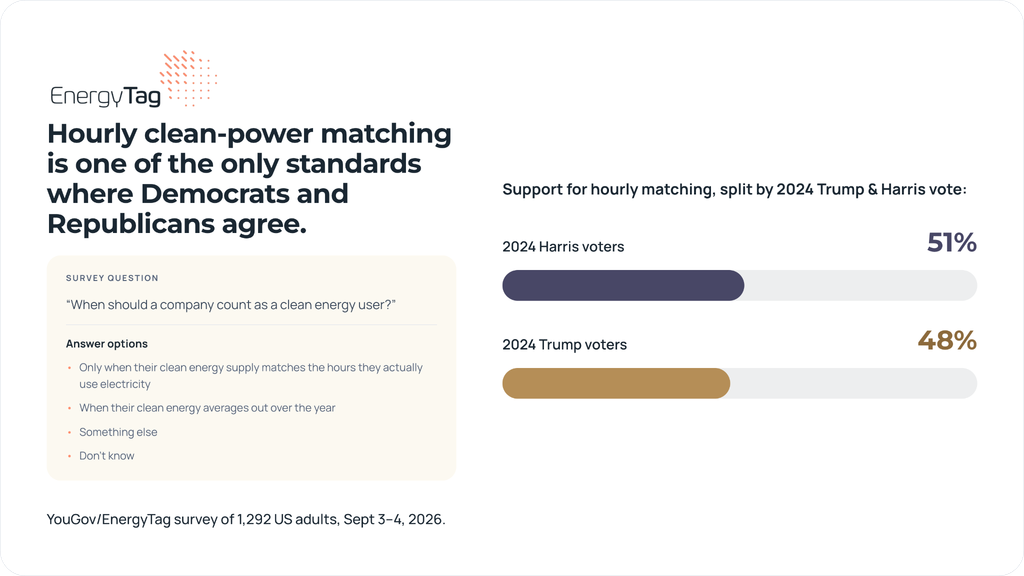
- Almost twice as many Americans say a company should only count as a clean energy user when its clean supply matches the actual hours it uses electricity, rather than averaging it out over the year — 45% compared to 22%.
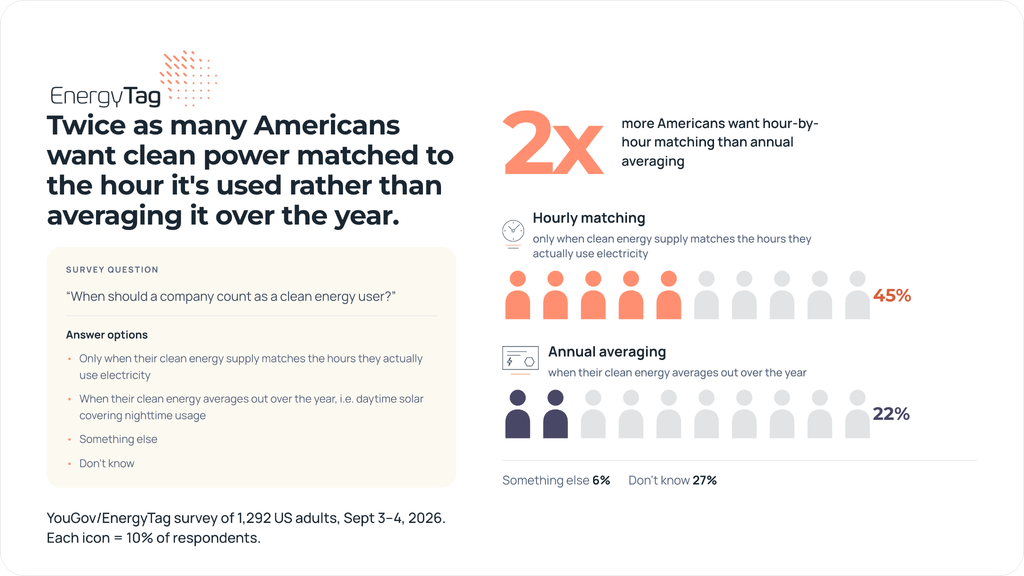
This is one of the only questions where the two political coalitions agree so closely.
51% of Harris voters and 48% of Trump voters back hourly matching over annual averaging.
Most Americans don’t believe today’s “100% renewable” claims.
The polling also finds a trust problem the industry has largely created for itself via the annual-average, location-agnostic claims mentioned previously. Given the varied definition of proving “clean energy”, the skepticism around companies’ claims isn’t surprising.
- Considerably more Americans don’t believe a technology company’s claim that a data center runs entirely on renewable electricity than those who do — 51% compared to 30%.
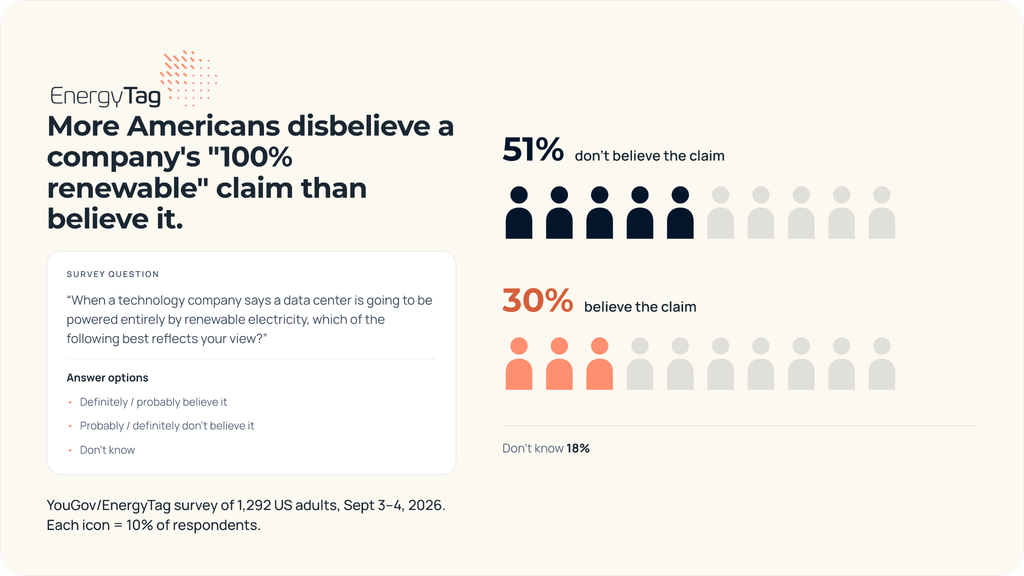
Belief in the 100% renewables claims varies a lot by age. 63% of over-55s don’t believe the claim, compared to 41% of 18–34s.
Being transparent about energy claims builds trust amongst Americans
The lack of trust isn’t static. The polling also revealed how companies can rebuild it: be honest about exactly how the data centers are powered.
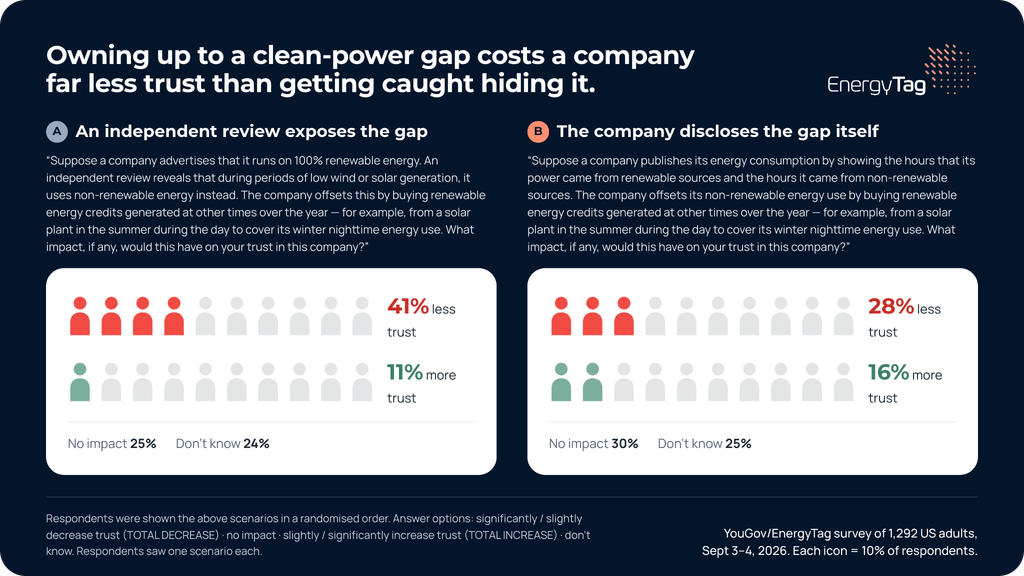
- When asked to imagine an independent review catching a company covering up a clean-power gap with annual credits, nearly four times as many Americans say it would decrease their trust as say it would increase it — 41% compared to 11%.
- When asked to imagine a company proactively disclosing the same gap itself, that penalty decreases: 28% say it would decrease their trust, and 16% say it would increase.
Bill concerns are a consistent theme
Clean, non-polluting power changes whether people are more likely to accept a data center. It does not yet convince them it will be cheaper.
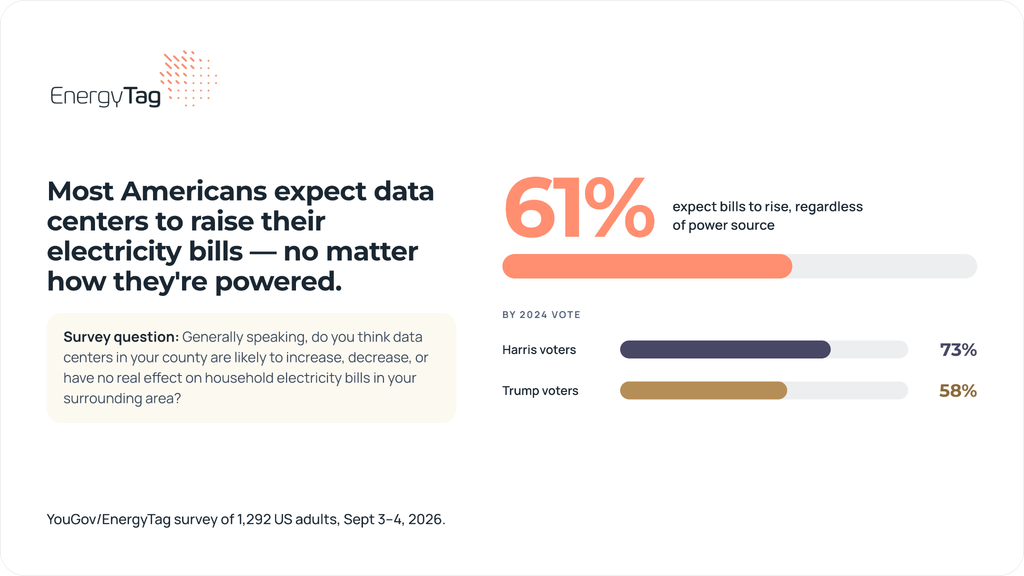
- 61% of Americans think data centers are generally likely to increase household electricity bills in their surrounding county — regardless of what powers them.
- This holds across party lines: 73% of Harris voters and 58% of Trump voters expect bill increases.
Concern about cost impacts rises with level of education
- 52% of Americans without a college degree expect bill increases, compared to 71% of 4-year degree holders and 68% of postgraduates.
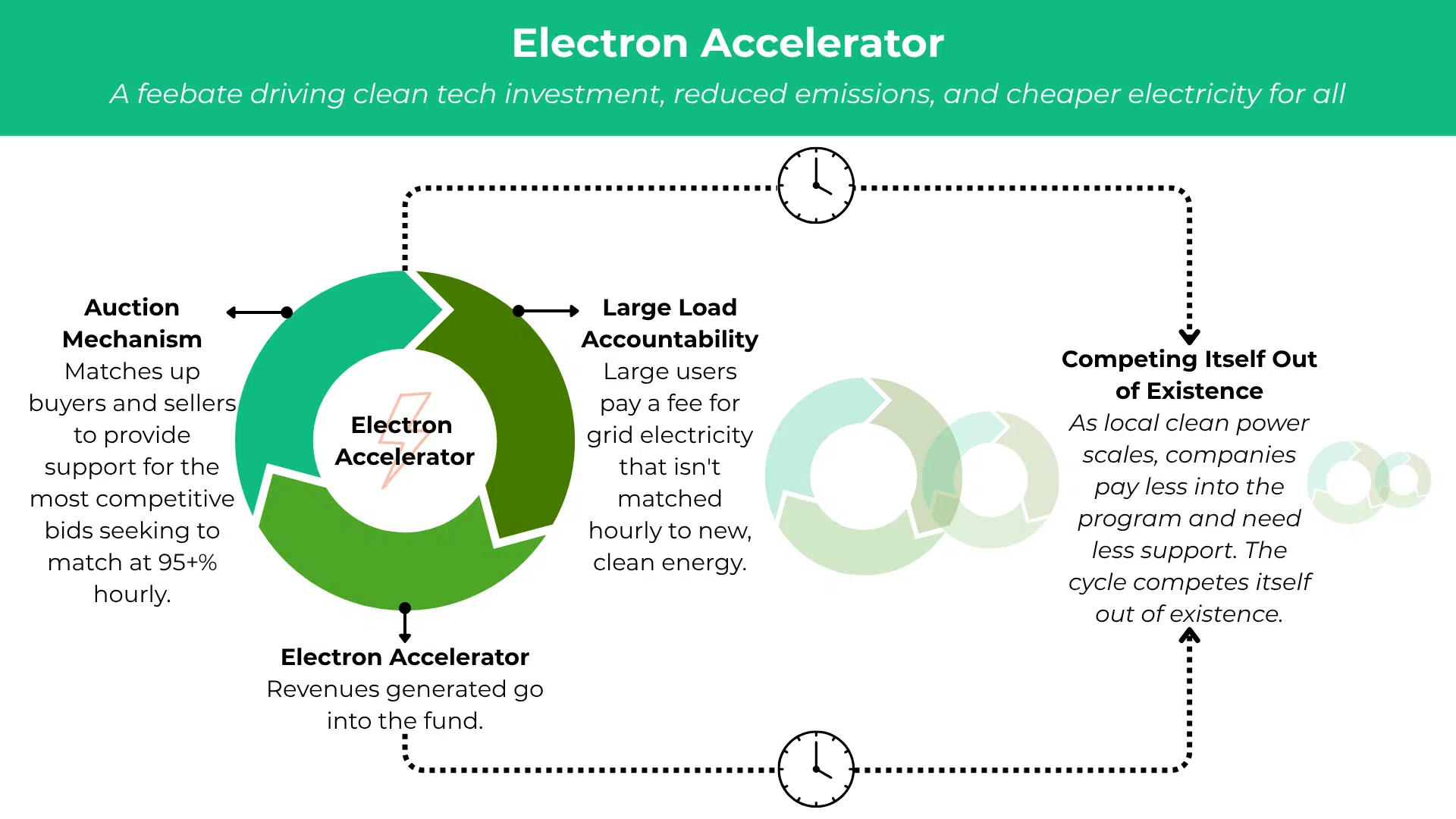
Data centers can be powered cleanly, with Big Tech footing the bill for the additional investment needed for clean, reliable power. Check out our Electron Accelerator policy mechanism which puts the responsibility for a cleaner, cheaper grid onto the data center companies themselves.
What This Means
Support for a data center depends heavily on whether it’s powered cleanly; trust in a company’s claims depends on whether it’s honest about the gaps in its clean energy claims; and companies powering their operations with local, hourly matched clean energy should garner more trust. These are both challenges and opportunities for Big Tech and the public.
America is at an inflection point. Data centers are becoming less popular, and accountability is needed. These large energy users represent a massive opportunity to invest in transformational grid updates and clean energy deployment for a more efficient, cost-effective energy grid. Some companies are already investing in clean energy to power their data centers and are showing the path forward. Others are building new, polluting fossil fuels, causing irreversible damage to our environment, which cannot be the solution. Requiring this industry to take the responsible path can lower costs and create a cleaner environment for everyone.
EnergyTag’s Electron Accelerator is a policy mechanism built for this moment. It holds data centers accountable for matching their power use to real, verifiable clean energy, and channels funds from those that don’t into accelerating clean energy for the ones that do. The House of Representatives Sustainable Energy and Environment Coalition’s Thriving Economy Project recently named the Electron Accelerator as a leading policy model for sustainable AI development.
About the Survey
All figures, unless otherwise stated, are from YouGov Plc. Total sample size was 1,292 adults. Fieldwork was undertaken between 3rd – 4th September 2026. The survey was carried out online. The figures have been weighted and are representative of all adults in the US (aged 18+).
Full topline and crosstabs are available here