

The US Electron Accelerator
Protect ratepayers, responsibly develop data centers, and provide around-the-clock clean energy incentives, all at once
The demand growth challenge
Today’s demand growth challenges in the US, led largely by planned data center growth, are bringing discussions of energy costs, availability, and affordability to dinner tables and legislative committees alike.
As electricity prices rise, tensions grow.
Data center developers and hyperscale technology companies (e.g., Google, Microsoft, Amazon, Meta) want to build as much and as quickly as possible, and some policymakers want to attract these developments.
However, many voters and policymakers are worried about rising energy costs as a result of increased data center energy demand and other secondary concerns, like pollution.
As data center demand continues to outpace available grid capacity in many locations and utility deals are privately negotiated, the public increasingly blames data centers for rising electricity prices. Increasing demand for power combined with equipment shortages has also resulted in increased costs of gas-fired electricity generators and grid infrastructure. These increased costs are typically spread across ratepayers and can further lock in higher prices for years.
In many states, electricity prices could go up by 4-5% next year, and in Texas, this could be as high as 79%.
Combined with pollution concerns, rapid data center growth presents a dual challenge, but also a massive opportunity to incentivize responsible development and accelerate long-overdue grid reforms.
Shared interests
Not everyone agrees that data centers should be built even if they use clean energy. And not everyone fighting to make data centers pay for the full cost of their power wants it to be clean. But, combining the two — requiring data centers to pay for the new, clean power that meets their demand around the clock — can bring more stakeholders together around requirements for data center deployment.
Polls show that using clean energy for data centers can help gain public support for new projects:
- Data centers powered by fossil fuels are opposed by a 16-point margin.
- Data centers powered by clean energy are supported by a +25-point margin.
The hyperscalers are racing to get data centers built and powered. Whether driven by profit, competition in the AI race, or local economic growth, there is value in seeking greater public acceptance by pursuing more responsible development. President Trump’s recent announcement with tech companies to protect ratepayers from adverse cost impacts of data center development shows just how politically salient it is to signal responsibility.
The question is: how can we bring all of these interests together? How do we align the interests to rapidly deploy data centers, make sure the development is responsible, protect ratepayers from increasing costs, and hold companies accountable?
A coordinated solution: The Electron Accelerator
The Electron Accelerator can deliver an elegant solution, valuable to stakeholders across this issue: affordable, clean power contracts that provide around-the-clock energy to large users like data centers.
If businesses could get reliable, affordable, around-the-clock clean power, they would jump at the opportunity. Many are already investing in clean energy, and we should continue to encourage those who have remained committed to doing so, but it is not always a priority given relatively cheap gas prices in the US and the current political environment1.
Policymakers and voters want data centers to be more responsible. So far, this has led to proposed legislation and regulations which require them to pay fairly for the energy and grid upgrades necessary to meet their needs. However, there is often no requirement for this energy to be clean, and there are even fewer proposals that require clean energy to be generating power at the same time the data center is operating.
The Electron Accelerator can support speed-to-power options for data centers while prioritizing social, environmental, and fiscal responsibility by making the data centers pay for around-the-clock clean power to meet their needs.
How does it work?
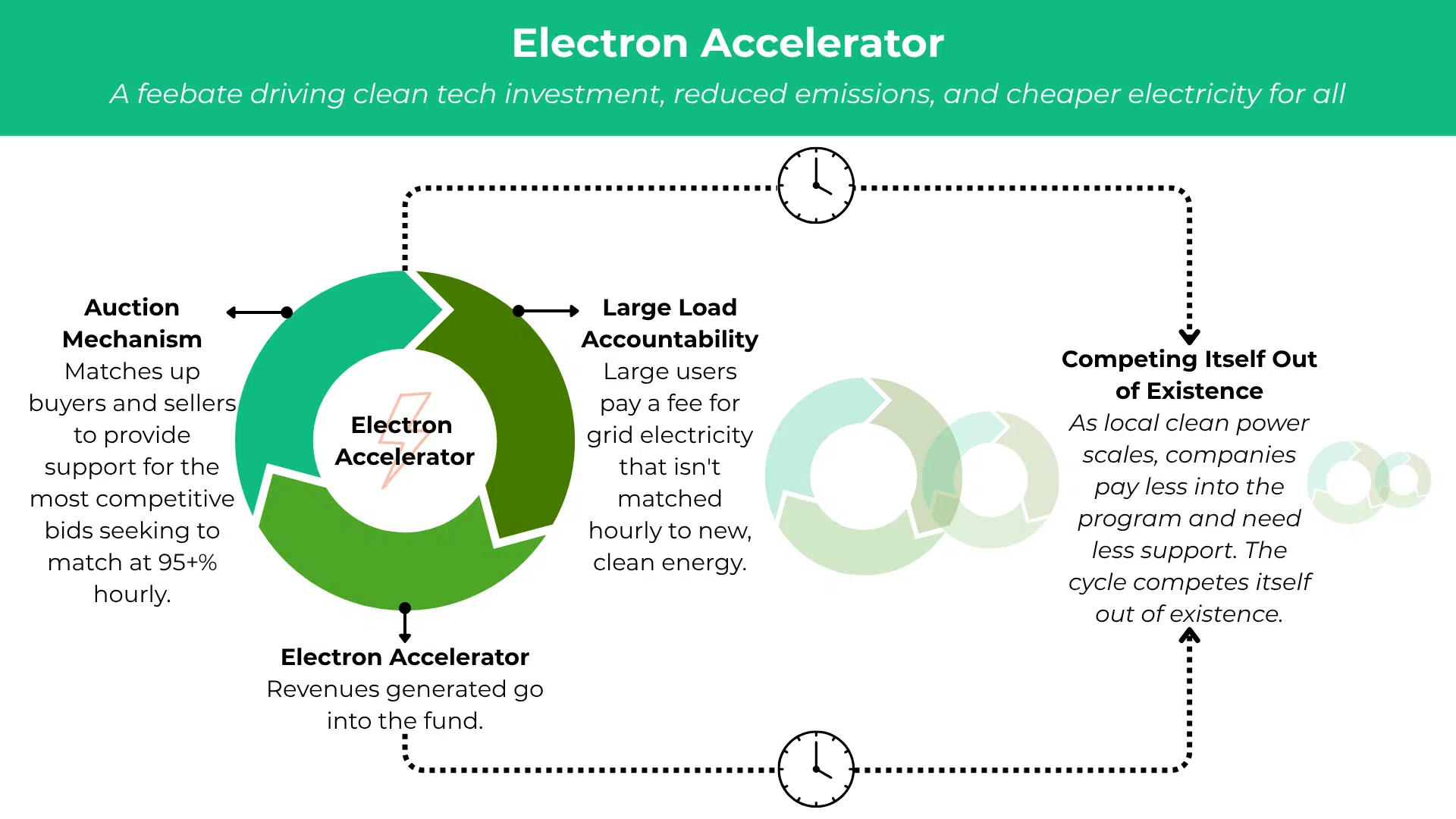
The Electron Accelerator would charge a fee on data centers for electricity usage that could increase costs and/or pollution for everyone. This money would then help pay for reliable, around-the-clock clean energy contracts for those same grid users. The program would work like a fee- and rebate (“feebate”) system on the largest grid energy users.
The Clean Cloud Act, introduced by Senator Whitehouse, offers one example for how the fee could be assessed. Data centers would be required to pay into the Electron Accelerator for the hours that they rely on grid power without matching their usage to new, clean energy in the same time and place. The program could alternatively be completely or partially funded via public money or from money raised via carbon pricing programs like the Regional Greenhouse Gas Initiative (RGGI).
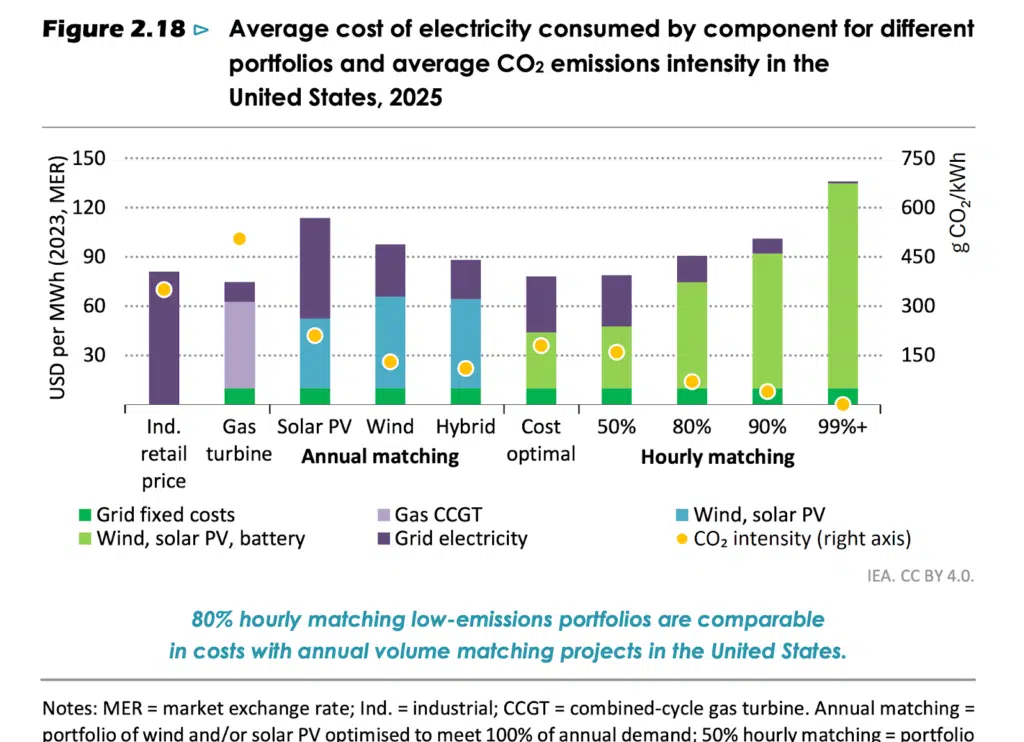
Those funds would be used in an auction format to help cover the cost difference between highly aligned clean electricity supply for a data center and the willingness to pay for that power. The goal should be to provide at least 95% hourly matched clean energy for data centers2. This could vary by location, but should be no less than 80%, as the IEA has shown this level of matching can be cost-competitive today.
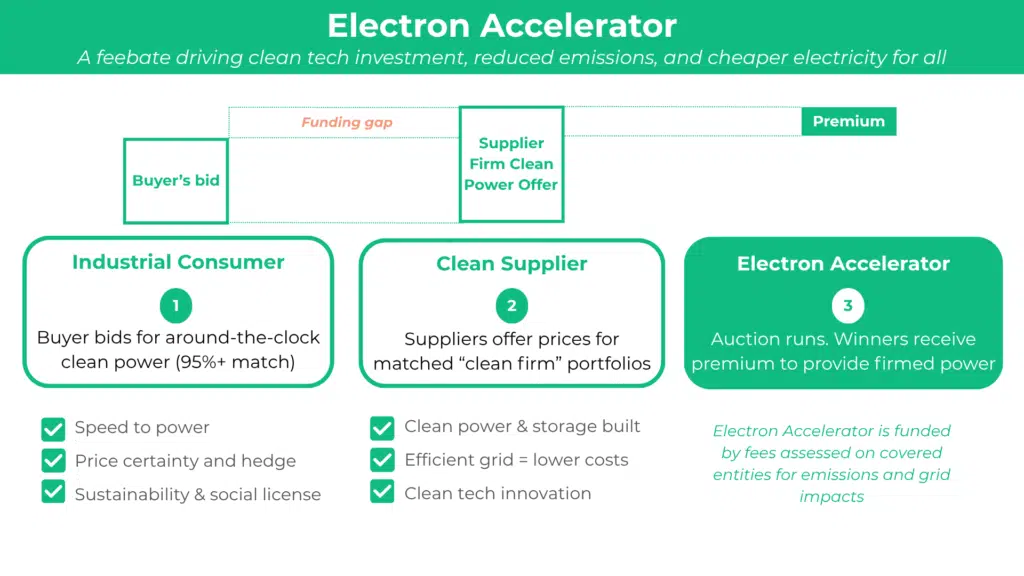
The Electron Accelerator auction would work like this:
- Buyers bid in with their highest willingness to pay for around-the-clock clean energy matching. They can include preferences on resource type, inclusion of flexibility and demand response, virtual power plant capacity, and more. This can be creative, driving new clean power and smart use of the existing grid.
- Suppliers see anonymized bids with preferences included. They offer the lowest priced product to deliver on those bids while still meeting the required hourly matching level.
- The auction runs and money is given out starting with the smallest price differences between willingness to pay and cost to serve. Projects continue to be paired, with the difference in price covered until funds are all used. If two suppliers have very similar offers, the one with a higher hourly matching score for the given demand portfolio should be chosen.
How would this work in practice?
Open below to explore a simplified example:
1) Funds are raised
- This can be done as described above via a fee assessed on data center electricity usage that is grid-connected and unmatched to clean energy purchases or that is on-site fossil fuel usage that increases emissions.
- Funds could also be raised via an existing carbon fee and/or supplemented with public funding.
2) The Auction is run
- Energy Buyer A wants to match its electricity usage for 95% of its hours with clean electricity. They have clean energy targets and they will better hedge their long-term electricity costs with a consistent supply of clean energy at known costs.
- Energy Buyer A bids into the Electron Accelerator with their highest willingness to pay: A 15-year contract priced at $100/MWh for their new 1 GW data center3. Their bid is anonymized, with preferences included such as an interest in long duration storage.
- Energy Buyer A bids into the Electron Accelerator with their highest willingness to pay: A 15-year contract priced at $100/MWh for their new 1 GW data center3. Their bid is anonymized, with preferences included such as an interest in long duration storage.
- Supplier B, operating as a supplier in a competitive market or a developer providing power in a vertically integrated market, sees the anonymized bid preferences but not the bid willingness to pay. They offer their lowest possible price to secure the new resources necessary to meet a 95% hourly matching profile with the preferences outlined. Their bid is $105/MWh to develop and procure enough new clean electricity and storage to meet Energy Buyer A’s demand.
- A number of other suppliers may also choose to submit bids to meet Energy Buyers A
- A number of other suppliers may also choose to submit bids to meet Energy Buyers A
- The Electron Accelerator, operating as a vertically integrated utility in regulated markets or a grid operator or state power authority in deregulated markets, then matches bids based on competitiveness. In this example, Supplier B came in with the lowest cost bid to meet Energy Buyer A’s needs. The Electron Accelerator guarantees to cover the $5/MWh difference for the lifetime of the contract.
- States and regions could choose to adopt different limits or guardrails on how much funding is guaranteed to ensure program viability.
How does this work with the existing clean energy market?
The Electron Accelerator puts wind in the sails of an increasingly competitive clean energy market.
A combination of renewables and storage can be built quickly, which supports the industry’s need for fast power. However, procuring enough renewables—combined with storage and innovative clean firm technologies—to meet demand at all hours is still expensive. The Electron Accelerator helps cover these costs for responsible energy users who want fast and affordable power, while helping companies lower their grid emissions. More on costs under “Is this possible?” below.
How does it impact electricity prices and costs to taxpayers?
The fund is coming from private industry, so it does not burden public budgets. This program can provide new, clean power for data centers without taxpayer support.
When large energy users come onto the grid today, even with their own power, they still rely on regular users to contribute more to ensure the grid operates effectively. This is because many of the “bring your own power” agreements only cover some of the hourly demand of a data center. For example, a data center might provide solar power during the day but still need energy at night. IEA analysis shows this mismatch can drive costs up for everyone by requiring more unnecessary gas backup to be built and run for purely peak demand — whereas highly-matched portfolios brought by corporates are much more valuable, mitigating the need for ratepayers to subsidize balancing resources.
The Electron Accelerator would support new, around-the-clock clean energy, which would more fully meet the new demand on the system and reduce the burden on the grid and ratepayers to support its operations. Incentives for around-the-clock clean energy matching also encourage more flexible operations from the data centers themselves, an innovative approach to coming online faster that delivers benefits for all grid users. A more efficiently utilized and flexible clean grid can lower energy costs for everyone.
How much will the Electron Accelerator actually be able to do?
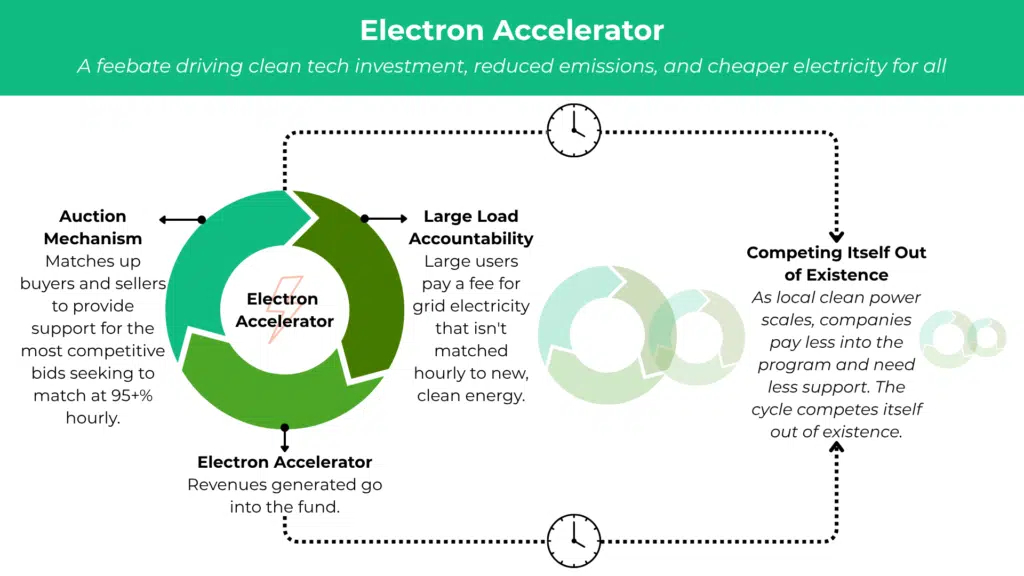
One of the key elements of the Electron Accelerator is that it will raise money based on how much work is needed. If there is high demand in an area relying heavily on still-dirty grid electricity, increasing costs and emissions for everyone, then this program would raise more money. This money could then be used through the Electron Accelerator to help those users build more clean energy. Over time, they will pay less into the program and need less help from it.
It is designed to compete itself out of existence.
Does this help everyone or just the companies?
Suppliers in the Electron Accelerator auction can secure price certainty for innovative, clean energy technologies like next-gen geothermal and long-duration storage. This allows them to invest in these technologies, which are necessary for our long-term grid decarbonization goals. The “flywheel effect” of investment in these technologies will bring costs down, encouraging more suppliers and buyers to include them in future deals and portfolios, continuing the virtuous cycle.
As more companies invest in local clean power, it creates jobs, reduces air pollution, and makes the grid more reliable, flexible, and affordable.
Is this possible? How much will it cost?
Meeting roughly 80% hourly matching is already cost-competitive today. Moving from 80 to 99%+ matching costs roughly $45/MWh, according to the IEA, which can be mitigated by the adoption of the Electron Accelerator4.
Source: IEA.
It should be noted that the highest costs of hourly matching come when going from 99% to 100%. The Electron Accelerator does not need to meet 100% hourly matching to be highly effective. Procuring clean energy at very high rates of hourly matching, like 95%+ is possible and can bring many benefits, like reducing pollution and reliance on expensive and volatile fossil fuels while bolstering system reliability across the grid.
With the Accelerator’s help, we can get there faster.
Around-the-clock clean energy is already happening, and the Electron Accelerator can speed up progress
Recent announcements illustrate the kind of clean energy procurement and planning that could rapidly accelerate with the help of the Electron Accelerator.
In Michigan, Google will bring 2.7 GW of new, clean power to the grid to power its data center at high hourly matching rates. Crusoe, a data center developer, is bringing a 12 GWh battery online — large enough to store renewable energy for days. At a smaller scale, Iron Mountain is deploying a 23 MWh battery to one of its data centers in New Jersey.
Duke Energy in North Carolina is working to help data centers to bring their own around-the-clock clean energy. And in Minnesota, Google and Xcel have agreed to deploy the world’s largest grid battery to meet growing demand, which will lower future costs for this important technology.
The Electron Accelerator can make these deals easier for big energy buyers, without burdening the public.
As states develop legislation to hold data centers responsible for their effects, like the strong bills in Colorado and Illinois, the Electron Accelerator can be an additional piece to the puzzle, supporting responsible and affordable demand growth.
What’s next?
It’s recently been asked where the new big ideas are for policy interventions that drive significant change to our energy system. We think we have one and we’re excited to talk about it.
The nature of the Electron Accelerator concept enables it to look different if implemented at the state or federal level. It can operate differently based on the specifics of each energy market in the US. There are ways to adjust the hourly matching requirements, the application of the fee, the amount of green premium guaranteed, the way the incentive is passed through, and the nature of the auction itself. We are hopeful for feedback, critiques, and ideas to further improve this concept.
- It is yet to be seen whether the historic interruption in energy markets changes this dynamic in the US. Europe’s gas and electricity prices are already seeing massive shocks similar to the Russia-Ukraine crisis impacts. With natural gas fired generation setting the marginal electricity price in much of the US for most of the time, there could be volatility to watch. ↩︎
- Hourly matching clean energy is the practice of an energy user purchasing clean energy resources (a combination of zero-carbon generators, like renewables and geothermal, and energy storage technologies) to ensure that there is enough clean energy being produced at any given hour to match the amount of energy being consumed by the same energy user. 95% hourly matching could mean that in 95% of the hours in a year, an energy user is fully matching its hourly energy consumption with purchased clean electricity production. Or, it could also mean that in every single hour, the energy user is matching 95% of each hour’s energy usage with purchased clean electricity production. A more nuanced backgrounder on hourly matching can be found here. ↩︎
- In some cases, a buyer may not want a single contract for their entire load. In that case, a buyer could bid for part of their load (500 MW for example) at 95% hourly matching and seek a match through the auction. This will still drive investment in around-the-clock clean energy portfolios and support long-term electricity price hedging for the buyer. ↩︎
- These costs are conservative. Research from Princeton University suggests that the 100% hourly matching premium could be between $27-40/MWh compared to 84% matching, depending on the participation rates. These numbers also exclude participation from advanced clean firm and long duration energy storage technologies; if included, costs could decline by 20%. ↩︎