

“Under the Hood” of the GHGP Scope 2 Consultation
Quick Take: Evidence Supports Reform; Anonymous Industry Predictably Pushes Back
In July 2026, Greenhouse Gas Protocol (GHGP) released the results of its January 2026 public consultations. The two consultations covered Scope 2 emissions reporting and a separate consequential emissions reporting framework. This analysis focuses on proposed updates to the Scope 2 market-based method (MBM) and their consultation responses.
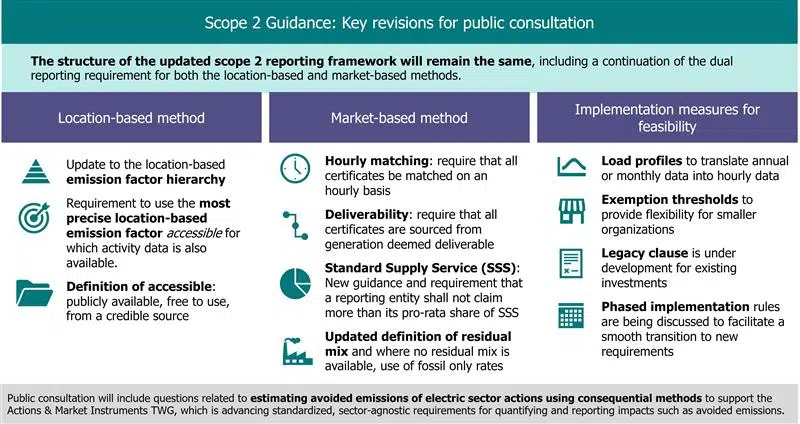
Source: GHGP.
Crucially, this consultation was a call for input – not a voting exercise – and is only one part of the GHGP revision process. GHGP’s decisionmaking prioritizes scientific integrity, environmental impact, and feasibility for its standards. Evidence quality of input should be more important to update decisions than “votes”. Per our evidence quality analysis, hourly accounting & other proposed updates came through strongly as the evidence-based approach:
- ~4x more likely that supporters cited peer-reviewed evidence versus opposers, rising to ~9x for named supporters versus anonymous opposers.
A credible coalition of leading companies, NGOs, academics, and others agreed that Scope 2 updates are needed for integrity and real decarbonization. They cited examples of 10+ TWh of hourly and locational accounting already being done today.
- Hourly accounting saw 4x more support from civil society and academics vs corporates.
- 70+ countries will soon have access to hourly certificates from upgrading registries.
- 100% of reporters would have immediate access to load/production profile fallbacks under the proposal.
GHGP published all 1,072 public responses to the Scope 2 consultation alongside a summary document. 54% of the responses were anonymous. Unsurprisingly, a large proportion (62%) of survey responses were from companies, industry groups, and consultants, as these organizations are the ones held accountable to proposed emissions accounting updates. And, predictably, they pushed back the hardest against the proposed more stringent reporting standards.
- 70% of companies submitted anonymously, while only 23% of academics did so.
- >2x more support for hourly matching from named respondents versus anonymous ones.
- 82-84% of respondents – dominated by industry – asked to keep flawed status quo rules.
A deeper look at the responses shows why topline headlines of support/opposition for proposed updates should be viewed with skepticism. Besides the 54% anonymity, there were also duplicate respondents, self-identified “NGOs” with commercial interests, and a considerable difference in evidence quality for those responding in support versus opposition.
- 12 responses opposing the updates came from the same electronics manufacturer group, among other examples of duplicates.
GHGP’s principled revision process now continues with the Technical Working Group (TWG) and International Standards Board (ISB) review. The final standard is now expected by the end of 2028 (formerly 2027), driven primarily by harmonizing GHGP standards with the International Organization for Standardization (ISO). The next harmonized draft standard is slated to be up for further public consultation in Q2 2027.
The Deep Dive
Quality Evidence Favored Reform; This is Not a Voting Exercise
GHGP has repeatedly said this consultation is not a voting exercise. Response quality matters, not raw numbers, and that evidence will be weighed according to GHGP’s robust governance process. Our analysis of citation rates and source quality shows that hourly accounting & other proposed updates came through strongly as the evidence-based approach.
The consultation was just one step in the process – a call for evidence – not a definitive ruling via popularity contest.

Source: GHGP Scope 2 proposal consultation document.
So beyond the simplistic headlines just giving raw numbers/percentages of those supportive/unsupportive according to a select number of multiple-choice questions, one finds much more interesting conclusions.
Under the Hood:
- ~2x more likely that supporters cited or referenced any evidence at all versus opposers.
- ~4x more likely that supporters cited peer-reviewed evidence versus opposers.
- ~9x more likely that named supporters cited peer-reviewed evidence versus anonymous opposers.
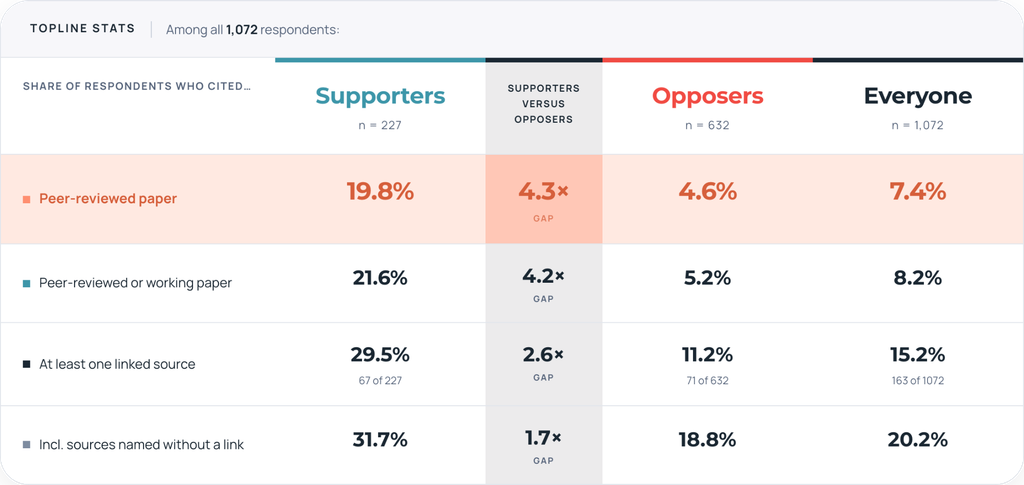
Reviewing the responses for sources – ideally fully cited and linked, not just mentioned – showed a real disparity. Supporters of the proposal were far more likely (~4x) to cite high-quality peer-reviewed evidence. This evidence showed the benefits of more granular emissions accounting and the need to move on from the status quo. Among their most-cited sources were from Princeton University ZERO Lab, TU Berlin, DTU, and others. Notably, multiple of the researchers themselves – including Jesse Jenkins (Princeton) and Iegor Riepin (TUB) – submitted comments in favor of reform, often advocating for even more stringent reform than the GHGP called for in the proposal. Leading academics exemplified this stance in a June 2026 public letter to the GHGP signed by 17 experts. They called for the GHGP “to advance and improve on the proposed MBM updates rather than retreat to a status quo that the evidence does not support.”
When opposers cited any evidence – which they did 2x less often than supporters – their most-used sources were heavy on non-peer-reviewed consultant reports, and often citing their own whitepapers and opinion pieces as evidence.
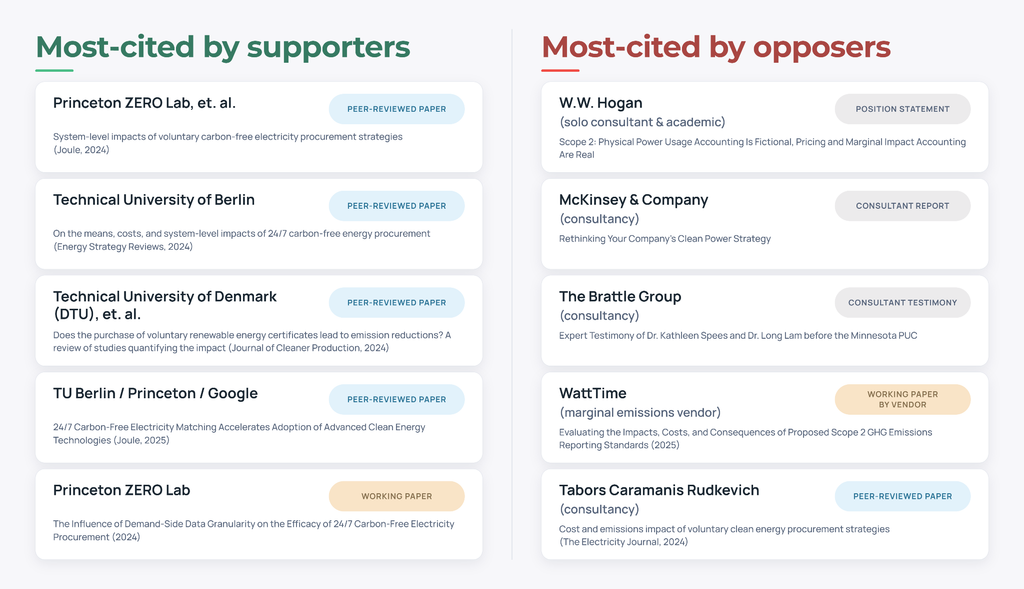
Other top supporter sources: NREL paper, IEA & NESO reports, US 45V hydrogen regulation.
Other top opposer sources: GHGMI blog, letters from ZeroGrid & ACORE, small CEBA survey.
When opposers cited peer-reviewed evidence, they often cited sources that generally support more stringent emissions accounting standards. These studies nearly unanimously find emissions reduction benefits from using accounting rules much like what was proposed by GHGP. Opponents’ continued assertions that proposed updates would be far more expensive rest heavily on modeling that forces immediate, full 100% hourly matching. This would indeed be difficult and expensive at present compared to 100% annual matching or emissions offsetting.
But these arguments are misleading, as research also shows sub-100% high levels of hourly matching still offer better emissions outcomes, and at a comparable cost to other approaches – and crucially, GHGP does not mandate matching targets. Companies remain entirely free to scale their clean energy matching based on their budget, climate ambition, and hedging needs, with GHGP only setting voluntary accounting standards for participants.
The only cost impacts are therefore “operating costs” of sustainability teams and tracking, which Watershed estimates “could rise by low single-digit percentages relative to electricity spend.” Each energy buyer decides their own level of ambition and how much they choose to spend on their clean energy procurement. Peer-reviewed academic research simply suggests that updated accounting rules will drive decision-making and deployment that leads to systemwide emissions reductions compared to the status quo, even under elastic demand.
In numerous instances, sources cited by opposers were focused on consequential methods – which are separate from Scope 2 in both GHGP’s standards and this round of consultations – so these were more of a “look over there” than a proper evidentiary claim for or against granular Scope 2 update proposals. The top-cited Hogan whitepaper goes a step further afield. Its argument contends that because electrons cannot be traced from source to site, the GHGP shouldn’t even bother requiring clean energy claims to have any correlation with the claimant’s consumption patterns or location. The peer-reviewed research heavily disagrees with this from a reporting integrity and emissions impact standpoint, yet this red herring was exceedingly prevalent amongst opposers.
The bottom line is that the evidence quality clearly both favors granular matching and is rightly more important to GHGP’s decision-making process than raw consultation response counts.
A Credible Coalition Supported Reform With Evidence and Case Studies
The consultation responses illuminated a credible coalition spanning the full spectrum of sectors in support of the proposed changes, contrary to the narrative of universal pushback.
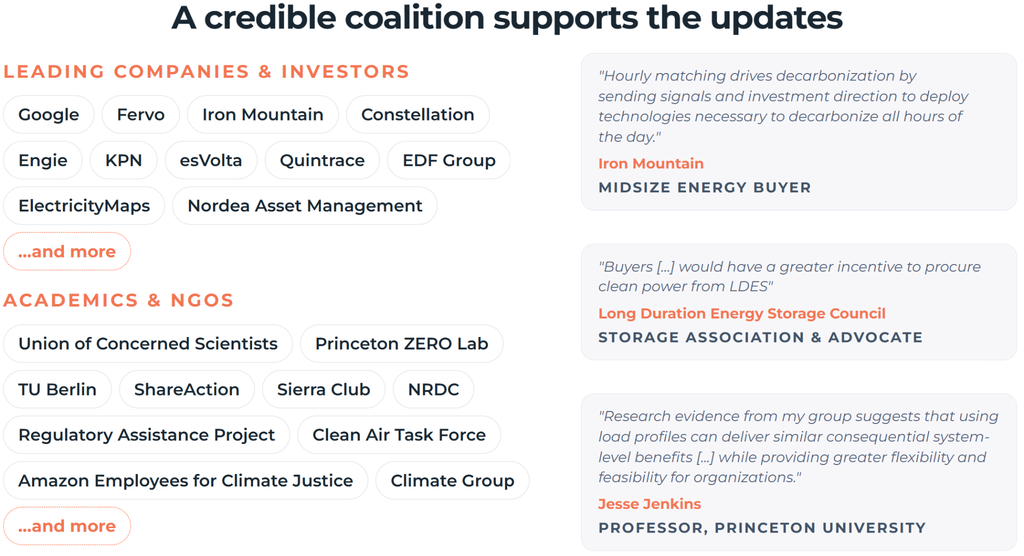
Leading energy buyers, like Iron Mountain and Google, explained why they are already pursuing hourly accounting and how they are doing it today. Leading suppliers offering hourly tariffs and tracking solutions, like Engie, explained how they are ready to enable this transition and are already implementing it today:
“As the decarbonization landscape matures, [GHGP Scope 2 MBM] should now evolve toward an approach that more accurately reflects temporal realities. ENGIE is committed to this trajectory and sees hourly matching as the desirable target model and supports the proposed change (hourly matching should follow a required ‘shall’ approach)”.
Advanced technology companies like Fervo are supporting these changes, joining battery storage developers like esVolta and other cleantech companies and advocates. They highlighted that these changes are critical to incentivize deep decarbonization technologies in ways the status quo “solar at night” accounting paradigm does not at all. In addition, a broad swath of major NGOs, including NRDC, Sierra Club, and Union of Concerned Scientists, supported transparency and impact alongside highly credible academics. This transparency is also important to major investors, with Nordea Asset Management saying (regarding proposed MBM updates):
“Speaking as an investor, these changes are key for ensuring comparability and usefulness.”
Under the Hood:
- 4x more support for hourly accounting from civil society and academics vs corporates.
- 10+ TWh of hourly accounting already done today with existing data infrastructure.
- 70+ countries where hourly certificates will soon be available from upgrading registries.
- 100% of reporters would have immediate access to load/production profile fallbacks under the proposal.
Many of these hourly tariffs and market solutions have been developed since the GHGP Scope 2 update process began. They emerged before the more significant demand-pull of the final standards has even arrived. And the baked-in GHGP feasibility measures of load and production profiles ensure that hourly accounting is possible on day 1, a further counterpoint to requests for indefinite status quo (“may not shall”) optionality and/or excessively long phase-in periods.
Industry Pushback Was Predictable and Deserves Scrutiny
Companies and industry groups dominated the responses. They were far more likely to oppose updates – and submit anonymously – than independent experts. This is predictable pushback. Companies frequently oppose more stringent environmental rules and should not be expected to en masse support rules that more rigorously hold them to account. It makes those that do support holding themselves more accountable all the more admirable.
- 62% of responses were from companies, industry groups, or consultants.
- 70% of companies submitted anonymously, compared to 54% of total respondents and only 23% among self-identified academics and researchers.
- 82-84% of respondents – dominated by industry – asked to keep flawed status quo rules when asked about concerns regarding deliverability and hourly matching proposals, respectively.
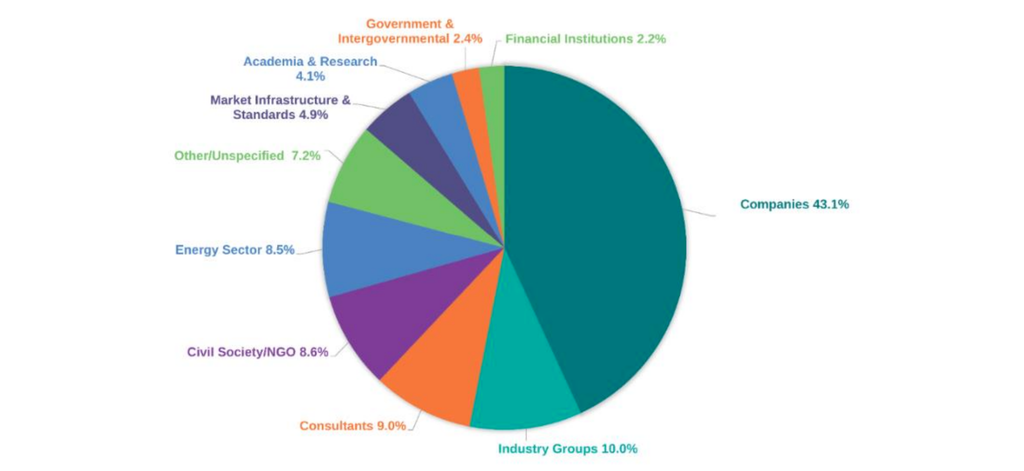
Source: GHGP Scope 2 Public Consultation Summary of Feedback.
Industry often requested maximum flexibility using the phrase “may not shall.” This means they want core hourly and local clean energy accounting updates to remain fully optional for all reporting entities, often indefinitely. Such a framework is basically identical to how status quo rules work today. This request is asking for Scope 2 rules written in 2015 to stay in place for the foreseeable future – potentially through 2040+ if the next update process follows a similar timeline to this one.
Among those who opposed hourly matching (and who answered the question asking for specific hourly matching concerns), 84% asked for this “may not shall” status quo. For the deliverability concerns question, it was 82%.
For years, a broad coalition has called out and studied how status quo rules are dated and flawed. Post-consultation, the GHGP stated that “feedback demonstrated strong interest in improving transparency and ensuring that reported outcomes and associated claims are aligned.” Broad industry desire to maintain a flawed status quo is counter to this claim. It also reinforces the importance of an update process backed by evidence, academic research, and thoughtful analysis – not an update decided by a vote.
Indeed, historical context shows why proposed environmental rule upgrades should not be determined purely by industry sentiment. Whenever important new environmental rules are proposed, it often follows a predictable pattern:
- Experts say the change is necessary.
- Industry says it’s impossible or it will be too expensive.
- The rule passes (when we show conviction) and the experts are proven right. The outcomes are overwhelmingly positive, and the projected costs were vastly overblown.
Consider these two illustrative historical examples:
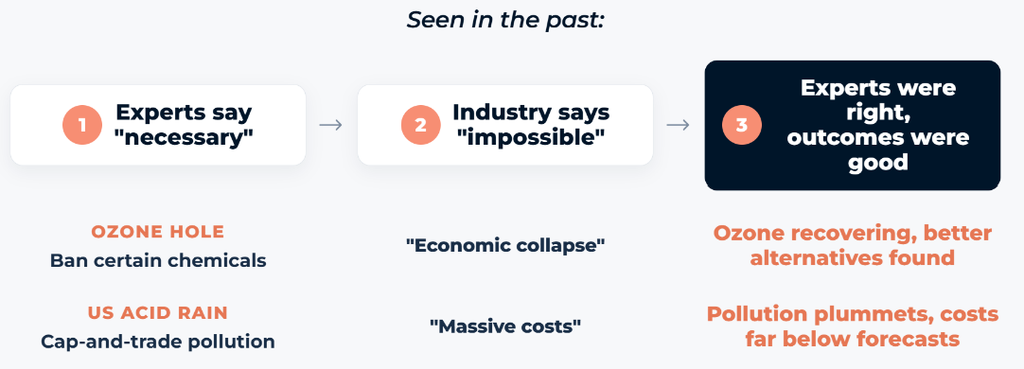
While the GHGP is not yet globally mandatory like the examples above, it is increasingly the foundation for major reporting frameworks. It underpins mandatory rules like International Financial Reporting Standards (IFRS) and Corporate Sustainability Reporting Directive (CSRD), and quasi-mandatory frameworks like the Carbon Disclosure Project (CDP). Other key policies – like the EU’s Carbon Border Adjustment Mechanism (CBAM), US & EU clean hydrogen accounting rules, and various proposed data center laws – also show the high-integrity direction of travel towards granular matching of clean energy to load.
Feasible stringency is a necessity for legitimacy and impact, even (or especially) within voluntary programs experiencing heavy lobbying from industry for leniency.
Nuance to Consider With the Consultation Responses
Upon deeper analysis, there are some details worth flagging which show why the simplistic topline stats must be taken with many grains of salt.
Under the Hood:
- 54% of respondents submitted anonymously, ranging from 70-71% for companies and financial institutions to 20-23% for data/analytics providers and academia/research.
- >2x more support for hourly matching from named respondents versus anonymous ones, with +10pp higher non-anonymous support for deliverability and Standard Supply Service (SSS) as well.
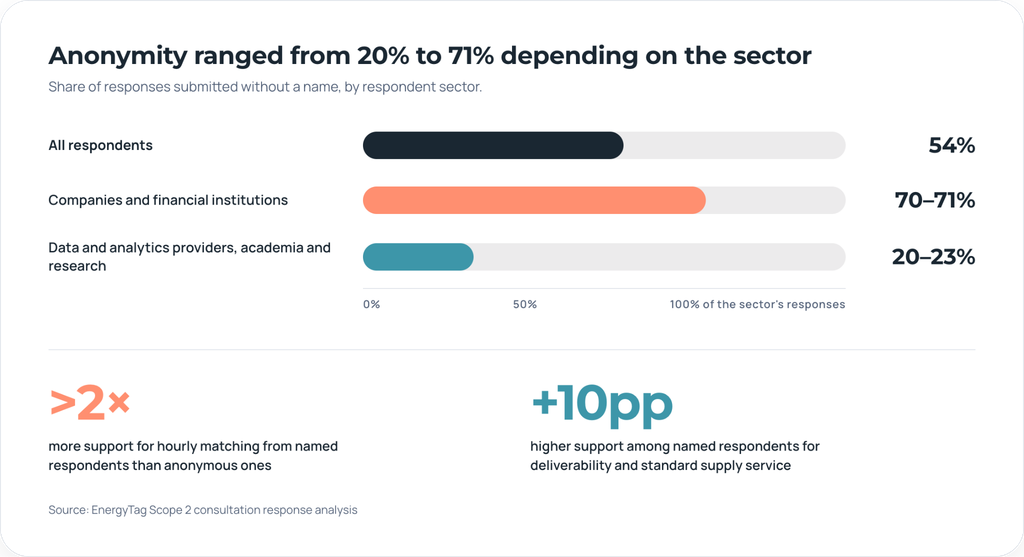
The glaring, unspoken issue is that over half the responses were anonymous (54%). This was a permitted option, so it’s not inherently foul play, though GHGP stressed this should only be for “exceptional circumstance[s]” – not a majority of responses. While GHGP themselves do know who each respondent was, the patterns – and unwillingness to attach names – say a lot. It introduces legitimately concerning questions around the potential for duplicative responses from the same organization or association – something already seen among named respondents – and the general transparency of this process to the public. This level of anonymity is quite unusual. It adds additional skepticism, and underscores the importance of an evidence quality analysis for each individual response versus unexamined topline numbers.
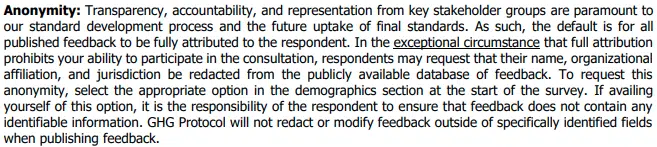
Source: GHGP Scope 2 proposal consultation document.
No Big Tech company named themselves in their responses except Google – who was strongly supportive of the proposed changes. This is interesting given the well-reported, heavy influence campaign by these companies on GHGP. All of them have a serious stake in the outcome. Many are pursuing massive gas-powered data center expansion, and these rules would make it significantly harder for them to continue advertising 100% clean energy procurement. In Meta’s case, one of the companies that do not appear in the named public responses, their new gas commitments have led to dismissal from RE100, a major sustainability framework and target-setting body. It is interesting for them not to name themselves in a response to this consultation, as these rules will directly determine what kind of public emissions reporting they would have to provide.
What about publicly identified responses?
Under the Hood:
- ~1/3 of those claiming NGO status had commercial interests, such as the Mining Association of Canada.
- 12 responses opposing the updates came from the same electronics manufacturer group, among other examples of duplicates.
GHGP allowed respondents to self-identify their organization type without audit. Among named responses, a closer examination shows about one third of those claiming NGO/nonprofit status were flagged as trade associations, business coalitions, vendors, etc. While these organizations may be “nonprofits,” there is a major difference between them. We must distinguish between mission-driven climate groups and those established to defend for-profit commercial interests.The Mining Association of Canada falls into this category, for example, finding itself in the same bucket as the Union of Concerned Scientists. These distinctions cannot be ignored or simply absorbed into unexamined headline stats. The nuance matters.
There were also several examples of the same organization or association submitting multiple times. At the most extreme end, there was one electronics manufacturer group Luxshare who submitted 12 filings under slightly different names or locations. And this is among named respondents – the anonymity rate of this consultation means there could be many more examples like this that cannot be readily identified by the public.
Finally, some of those who responded in opposition still recognized hourly & locational matching as the correct and high-integrity direction of travel. These responders were hesitant or had specific concerns, plenty of which are addressed by GHGP’s proposed flexibility measures.
These nuances, coupled with the predictability of industry pushback versus the credible coalition in support (and demonstrating feasibility today), only raises the salience of GHGP’s focus on evidence quality.
In Short:
Every consultation response should be considered in a vacuum. Each one’s impact on the ongoing GHGP Scope 2 update process should be based on evidence, clarity of argument, integrity, and effort to contribute constructively. Per our evidence quality analysis, hourly accounting & other proposed updates came through strongly as the evidence-based approach.
This consultation is a useful step in the overall process, but it should be seen as just that: one step. As EnergyTag has dived deeper into the responses, it is clear that while numerous responses provided useful feedback, many others contained concerning trends and therefore deserve greater scrutiny.
What’s Next?
Taken directly from the GHGP itself:
“In response to the public consultation feedback, GHG Protocol will revise the consultation draft with the Independent Standards Board ([ISB]) and TWG (Technical Working Group). The ISB and TWG will explore whether offering multiple reporting approaches that reflect different theories of change could best respond to the diverse views represented in the public consultation feedback. Any further proposals will follow GHG Protocol’s standard development process including development by the Technical Working Group and review and approval by the Independent Standards Board.”
In addition to the procedural and governance factors outlined above, that “standard development process” refers to the GHGP’s decision-making hierarchy of scientific integrity, environmental impact, and feasibility. You can read more about GHGP’s processes in their SDP here, where you will also find the updated Scope 2 revision timeline reproduced below:
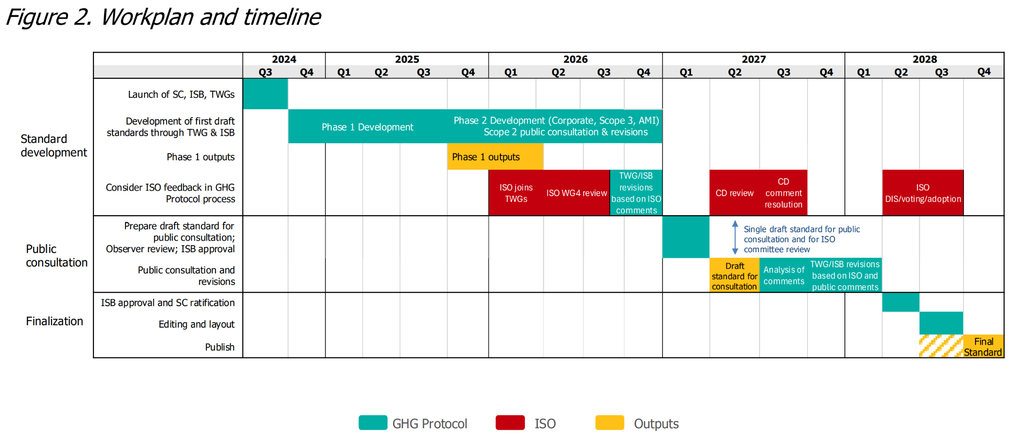
Source: GHGP.
Following TWG and ISB deliberation and approval in the coming months, GHGP expects another potential public consultation in Q2 of 2027, with final publication of the new standard by end of 2028.
This final publication is 1 year later than GHGP originally anticipated (Q4 2027), “driven primarily by the GHG Protocol–ISO Partnership and the integration of ISO’s processes into the timeline” according to GHGP.