

It Can Actually Be Quite Simple
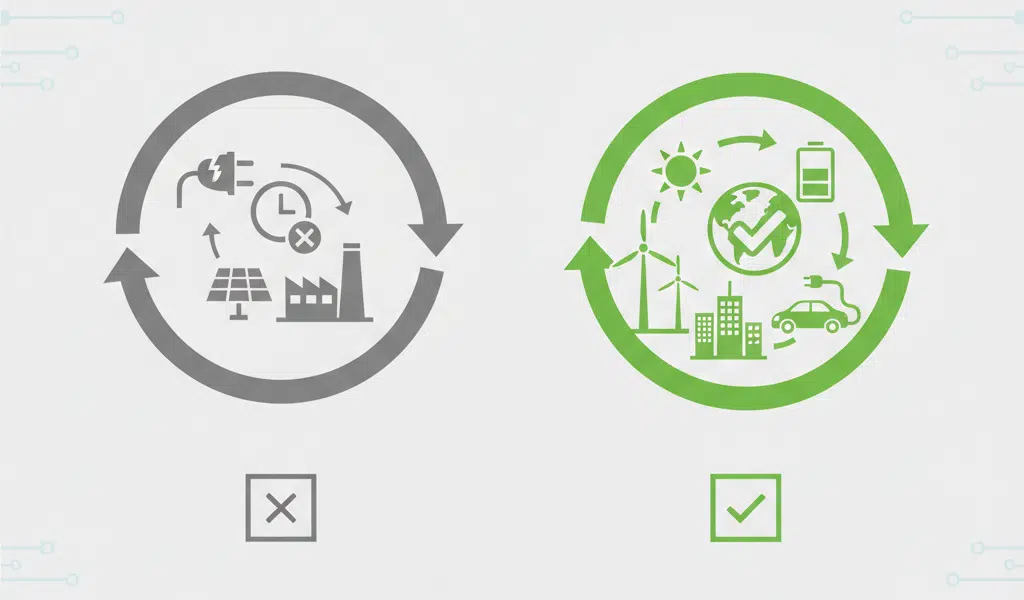
Greenhouse Gas Protocol rules that ignore when and where electricity is produced do not meet the moment and cannot guide a transition to a decarbonized grid.
- Scope 2 accounting attracts complicated rhetoric, but it can also be simple
- Basic integrity matters, something today’s rules lack
- Beware of misleading fictions about what’s on table
- Impact matters, and the proposed rules updates are needed to drive the necessary clean energy technologies onto the grid
- These changes are feasible and flexibility has been thoughtfully introduced
- These rules will reduce the ability for large energy users to freeload off ratepayers
- True 100% clean electricity is difficult and will take time — and that is ok to admit! Let’s celebrate progress over “on-paper perfection”
- Now is the time to be brave in the face of adversity and political headwinds, not give in to them
- Make your voice heard. Comments are due January 31.
There is only one week left to influence the direction of the Greenhouse Gas Protocol Scope 2 updates — changes that will shape how nearly every company in the world plans, procures, and claims clean electricity.
These global emissions reporting “rules of the game” set the incentives for the world’s largest buyers of clean energy. These incentives can either serve the interests of greenwashed “100% clean” electricity claims, or they can drive investments toward more effective deployment and use of renewables, storage, clean innovation, and flexibility.
Scope 2 accounting can be complex, but the proposed changes are also quite simple
The Greenhouse Gas Protocol’s update process requires that any final rules must strive for integrity, impact, and feasibility.
A few simple questions illuminate the need for change and demonstrate how the proposed updates address these metrics.
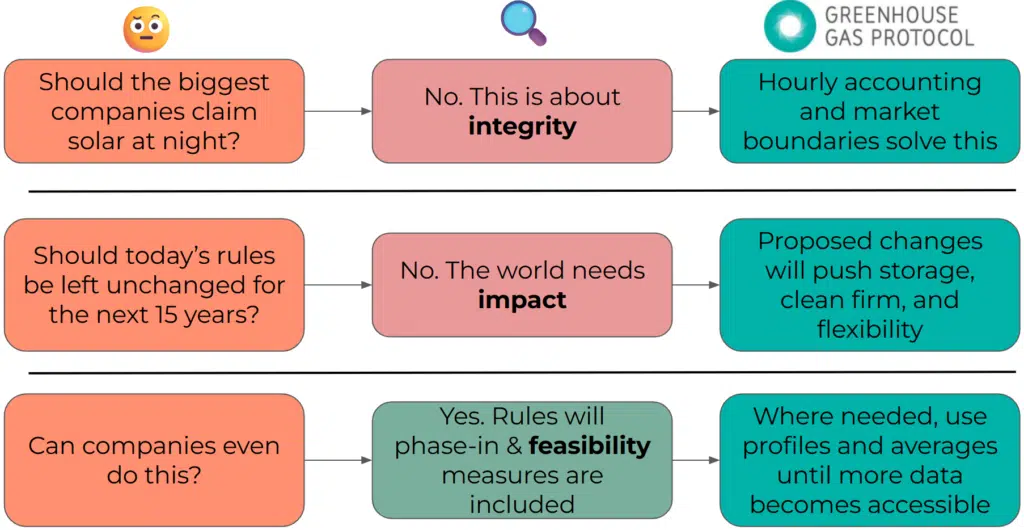
Source: EnergyTag (not a GHGP graphic).
Today’s Scope 2 rules lack the basic physical accuracy and integrity necessary to drive investments, planning, and flexibility for full grid decarbonization.
Let us take a big step back. At its core, this is an accounting standard that governs how companies voluntarily report emissions from electricity use and procurement.
Today, these rules allow Californian solar fields to decarbonize data centers at night in Virginia and old hydro plants in Norway to decarbonize industry in Spain. They lack correlation in time and location between electricity production and consumption, enabling claims of “zero-emission” AI data centers that are, in reality, backed by new fossil generation.
A company, like the one described above, that buys distant renewables with no operational connection can claim the same zero-emissions outcome as one that invests in local clean power, storage, and flexibility. On paper, today’s rules make these very different strategies look identical – exposing a fundamental weakness in the status quo.
And besides the fairness of it all, are we comfortable entering the late 2030s with the same rules today that allow companies to claim zero electricity emissions by buying distant solar with no plausible connection to their electricity usage?
On its face, it is silly. As we move into a decisive decade for decarbonization, the bare minimum should be to require greater accuracy in the accounting. From there, we can build policies, incentives, target-setting strategies, regulations, and procurement best practices that further drive the most efficient, deep decarbonization possible.
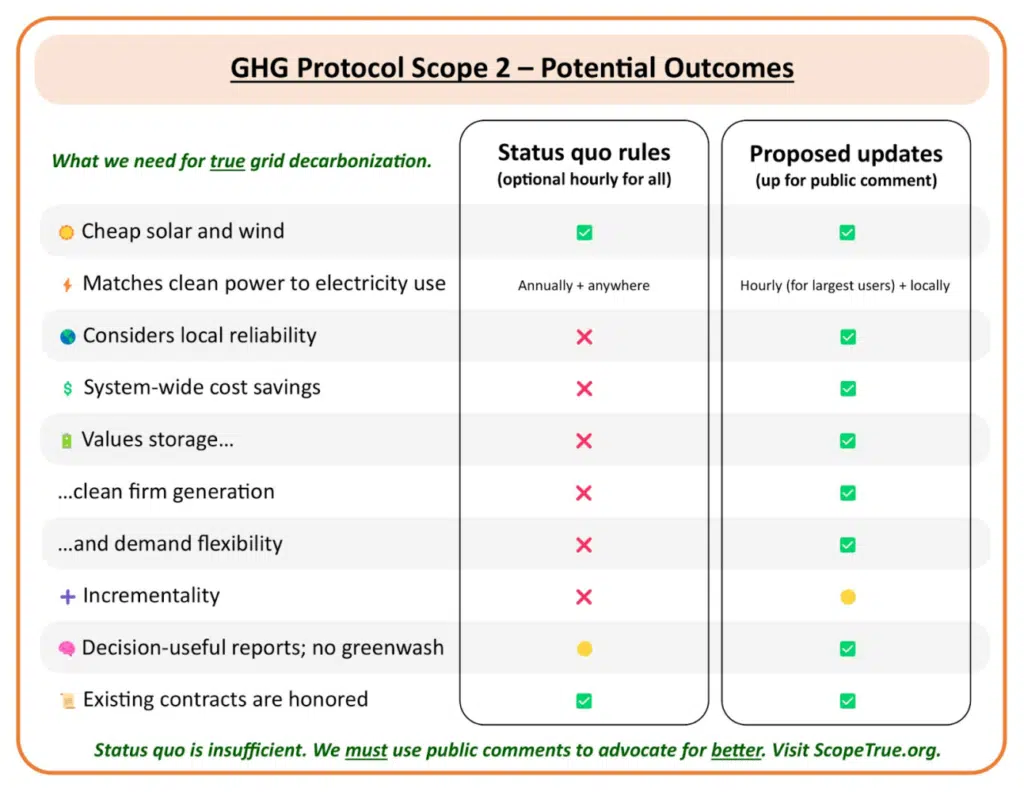
Source: EnergyTag.
Beware of these fictions!
- “May not shall”
There are stakeholders in this process advocating for a “may not shall” approach to the rule updates – this would make hourly accounting and local matching fully optional for everyone. That’s already the case today. This optionality does not enable some new flexibility – it entrenches the status quo. We cannot afford these fundamentally flawed rules to persist through the late 2030s as we move to rapidly decarbonize everywhere, all the time.
- “I don’t have the data to do this”
There are a number of feasibility pathways designed to make more accurate accounting possible for everyone (even while most companies are likely to be exempted from hourly accounting because of a proposed flexibility threshold). Today, there are over 50 suppliers providing hourly matching products and more coming all the time. If that is not available in your market, using monthly or annual data with a profile for load and generation is allowed. If load profiles are not available, even a time-of-use average (peak and off-peak usage) or a flat average (divide by the hours in a year) is allowed! The point is, the proposed changes will improve accuracy of reporting compared to today’s rules, and the proposed feasibility measures make this greater accuracy even easier. There are even calculators publicly available today from Constellation and WattTime/REsurety to help companies understand potential hourly Scope 2 emissions, well in advance of final rules. Note: results using these calculators may vary and methodologies should be published and examined, but it shows just how feasible it is to develop and use tools to meet the proposed accounting rules.
- “This forces everyone to do 24/7”
No it doesn’t. Anyone saying this is intentionally or unintentionally misrepresenting what is being proposed.
- “This is too expensive”
Besides the fact that companies can decide for themselves how much they choose to spend on their decarbonization strategy, there is research from the IEA and others showing high rates of hourly matching are cost competitive with annual matching and industrial retail tariffs! We can get the benefits of greater integrity and impact at comparable prices. Hybrid renewables will get cheaper over time. To bet against hourly matching is to bet against the promise of cheap around the clock clean power.

Source: IEA.
- “Companies should be rewarded for the good they are doing”
Of course companies want to be able to say they have zero emissions in their electricity supply. We want that too! But it matters whether that statement is true or not. If we allow companies to make claims of “100% clean” electricity purchases under rules that defy common sense, we are allowing the world’s largest energy users to say “my job is done” well before it actually is.

Source: IEA.
The proposed rule changes will allow companies and the outside world to all transparently see where and when more clean energy is needed to make highly credible claims of low emissions electricity procurement. Let’s celebrate real progress and not a false perception of “perfection.”
These rules align with high impact procurement and raise the very low floor today.
Most clean energy buyers and the bulk of total clean energy procurement around the world rely on unbundled RECs detached from consumption and similarly low quality claims. Proposed changes to the standard will raise that floor to ensure these RECs cannot be bought from anywhere at any time – a farce well recognized as greenwashing today.
These rules also align with high impact contractual procurement many companies already pursue. The only thing that will change is how those contracts can be matched to consumption. This will further encourage demand flexibility and the addition of technologies like storage to better match contracted clean power and actual electricity usage.
Finally, a legacy clause will likely ensure that existing contracts use today’s accounting rules to avoid any regulatory cliff for existing investments. Details on how that is designed are one of the key consultation questions. We encourage consultation respondents to thoughtfully consider these questions and engage on the topic.
The current rules incentivize corporations to source renewables when and where they are most abundant without having to address integration issues – a cost then thrust onto all other grid users
Today, companies get credit for renewable energy no matter where and when it is produced. That incentivizes them to buy clean energy wherever it is cheapest. That is why we see such significant investment in Texas and Spain — markets where it has been easiest and cheapest to buy wind and solar. However, when renewables are deployed without firming technologies like storage and are disconnected to the demand they are supposedly matching, there are costs and inefficiencies created as the most expensive and fossil-heavy hours can be ignored. Grid operations require constant balancing of supply and demand, and when companies are allowed to ignore this reality (by buying solar faraway and using electricity around the clock) the actual costs of this balancing are borne by the ratepayers.
Without these needed rule changes, the largest energy users will continue to free-load off the grid at the expense of individual ratepayers.
Scope 2 will be separate from impact accounting — and that is ok!
The GHG Protocol has clarified how and why Scope 2 updates (inventory accounting) should be separate from impact accounting (a process to estimate what amount of emissions have been avoided by investing in clean energy). These two processes serve very different purposes, can both be decision-useful, and should both be productively engaged during their simultaneous consultations.
FULL decarbonization will be difficult and take time — and that is ok to admit! We need to know when and where to invest, deploy, and focus.
We cannot manage what we cannot measure, and this protocol update means we start to truly measure Scope 2 emissions inventories.
Transparency and honesty means we get to work towards real decarbonization from a place of common understanding. When Scope 2 emissions numbers are based on greater physical accuracy, companies and the public will have a better sense for when and where we need to invest in more clean technologies.
The public will need to support companies on their more impactful journey to zero emissions – as new rules phase in over several years, companies that may have been “100% clean” under old rules of the game may now have a lower “% clean” score under new and improved rules of the game. EnergyTag stands ready to ensure that any changes to a company’s Scope 2 emissions number is met with encouragement, not derision.
We cannot let current political attacks and fear undermine the progress we know is necessary.
The current political environment has made clean energy investments more difficult and can discourage companies from stepping out on a limb to lead on climate. However, it would be self-sabotage as a community invested in the clean energy transition to allow today’s fear-mongering and attacks to prevent us from making necessary, ambitious steps forward. Remember, these rules will likely not come into effect until 2030 and will be in place until nearly 2040. They will outlast today’s political and market dynamics, so we need to make sure they reflect the kind of clean energy procurement and emissions claims we want a decade from now.
Whether you are a corporate energy buyer, producer, sustainability lead, grid expert, advocate, clean energy developer, or concerned citizen, your input matters.
Make your voice heard. Comments are due January 31, 2026.
- Use EnergyTag’s Guidebook for more information and to help draft your answers.
- Respond to the GHGP Consultation Survey.