


Making the Sun Shine At Night
Solar power, wind, and batteries can combine to provide on-demand power. As COP31 progresses, projects in the Gulf, India, and Africa show how renewables can keep the lights on after dark.
Since November 9, governments have been meeting in Antalya for COP31. The Turkish presidency is pushing a “35 by 35” goal to lift electricity to 35% of global final energy use by 2035. To electrify fast; we need affordable, abundant power fast. And we need it when it matters. Renewables and batteries, which now dominate global capacity addition offer the only credible route. But, there’s a catch.
Can renewables be delivered even after the sun goes down or when the wind stops blowing?
Earlier this year at a London energy summit, IEA head Fatih Birol warned we are living through the largest energy disruption in history. Shortly after, he shared his “biggest hope”: continuous solar thanks to batteries. Not there yet. But coming.
Today, most markets and policies don’t incentivise firm renewables. We need to reckon with and address this, this will take root and branch reform. But, the journey has begun.
A solution hidden in plain sight
In Abu Dhabi’s Al Dhafra desert, Masdar is building a project that will change how the world sees renewables. Reaching a $6.1 billion financial close in July, its 5.2 GW of solar panels and 19 GWh of batteries will deliver 1 GW around the clock – matching a nuclear reactor’s output but with just a two-year build time. At ~$70/MWh (per IRENA), it easily rivals Lazard’s $51–$129 benchmark for US gas power.
Solar is now cheap enough that when stored and dispatched at night, it undercuts new fossil capacity across most of the sunbelt home to 80% of humanity. A recent IRENA report shows solar, wind, and battery projects can deliver continuous power at prices competitive with coal and gas. Costs are expected to drop another 30% by 2030, driven in large part by plummeting battery costs, down 93% since 2010.
Some projects are already making the sun shine at night. In August, Africa’s first 24/7 solar-plus-storage plant went online at a DRC copper mine. Combining 233 MW of solar with a 526 MWh battery, it guarantees 95% power availability and was running just 16 months after the power contract was signed. Despite vast solar potential, Africa relies heavily on imported fuel. This project demonstrates there is a new path to rapid, on-demand clean power for local industry and communities.
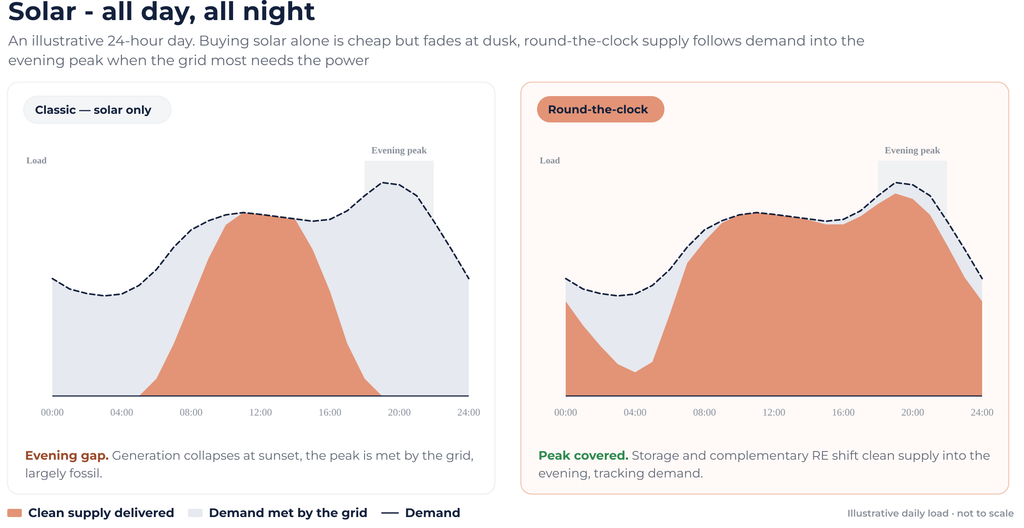
The ingredients are simple – solar, wind, batteries. Blending them with storage shapes these inputs into reliable supply, matching fossil fuel plant operating hours. The focus now must be on scale.
India is building a new model for the world
Technology is only half the story. Renewable projects advance when long-term revenue is guaranteed by government auctions or corporate buyers. Historically, these have been designed to favour wind or solar. Even if the numbers pencil, firm renewable power won’t get built unless the projects are bankable.
India bucks the trend. Auction rounds mandate that developers guarantee power supply during specific peak hours, especially in the evening. Developers select their own mix of solar power, wind, and storage, but incur penalties if they fail to meet availability targets, say set at 90% during peak demand. India’s firm-supply auctions clear at 50–65/MWh. Berkeley researchers find this model provides 95% availability at ~$70 – cheaper and more continuous than India’s coal fleet.
To the victor go the spoils
In its Energy and AI report, the IEA modeled over 1,000 wind, solar, and battery configurations across the US, Europe, and China. Portfolios meeting 80% of data center demand hourly are already cost-competitive with industrial grid power in all three regions.
Speed to power is everything in the AI race. Solar-wind-battery facilities take just one to two years to build once permitted. Conversely, new gas turbine lead times have stretched to five to seven years. As governments race to meet rising power demand, firm renewables offer the rapid deployment required.
For fossil fuel importers, the security rationale grows daily. With the Strait of Hormuz crisis disrupting a fifth of global LNG, Asian nations scrambled for supply, with some turning back to coal. Installed solar and battery assets need no safe passage through global chokepoints, enhancing national energy sovereignty. Recognizing this, a Spanish regulatory proposal would require data centers to cover 80% of hourly demand with new renewables to manage prices and security.
Change comes only with action
Despite early progress, this emerging sector comprises only a handful of flagship projects and requires a decade of focused support from governments, lenders, and buyers to scale. There are still significant challenges. Achieving 100% reliability remains cost-prohibitive during extended low-sun and low-wind periods (leading even ambitious projects to target 90–95%), and technology supply chains remain heavily dependent on China.
Conventional plants will linger as backup until long-duration storage and similar technologies mature.
Antalya is the place to build that support. Variability has long been renewable energy’s Achilles heel. That era is ending as batteries unlock an industrial age powered by sun, wind, and storage. Energy crises historically spur profound change. This time, round-the-clock renewables can have a central role, if policy let’s them.
