


Spain’s data center decree keeps nearly €2 billion a year off consumers’ bills
Summary
-
- Spain’s government is doing the right thing: Its latest decree requires new data centers to bring new clean power, matched hour by hour. Without that, everyone pays more for electricity.
- No rule, higher bills: one 500 megawatts (MW) data center adds over €300 million a year to consumers’ bills. A 6 gigawatts (GW) buildout adds €2.6 billion.
- Hourly matching protects consumers: with the decree’s 80% hourly rule, the data center pays for its own clean power and batteries, taking the cost off consumers’ bills entirely (from over €300 million a year to about €1 million).
- At full buildout, prices rise 14%: data centers already hold 6.3 GWs of grid access. The decree’s rule removes 72% of that price rise and 99% of new emissions.
- Less gas, less risk: the rule also cuts extra gas burn by around 98%. With gas prices currently at €100/MWh, that protection matters even more right now.
Spain is Europe’s test case for affordable AI growth
In the US, the AI boom runs on gas: developers plan 165 GW of it to power data centers directly. Spain’s new decree, approved 20 November, takes a different, better path. New data centers must bring new renewables, matched to the hours they use power. EnergyTag and PyPSA Labs did an open-source study of Spain’s power system to test what is at stake for consumers.
Who pays for a new data center?
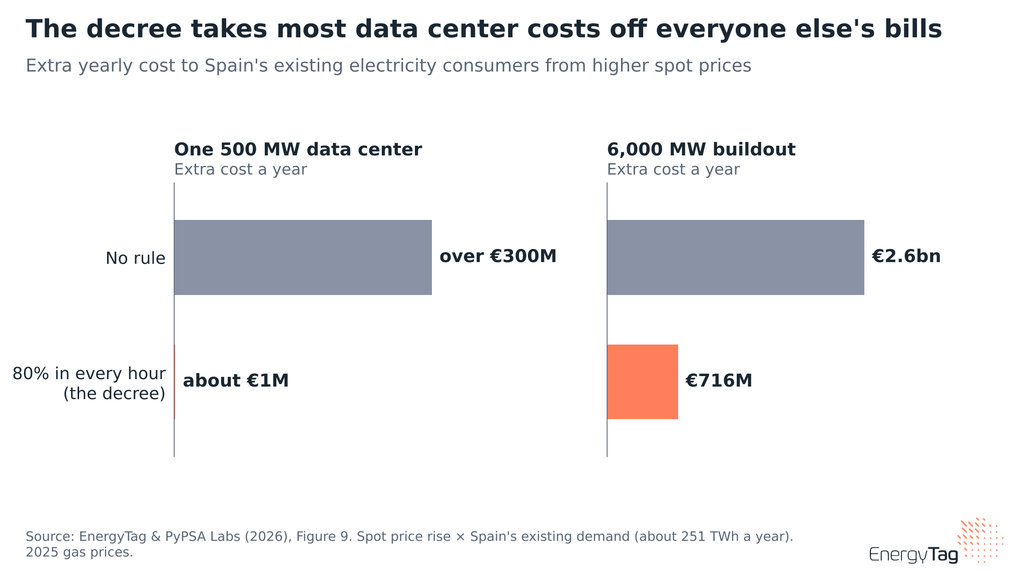
How to read it: each bar shows how much more Spain’s existing electricity consumers pay a year because new data centers push up the spot price. Grey is with no rule, orange is with the decree. Left: one 500 MW data center. Right: the 6 GW buildout.
Without a rule, existing gas plants fill the gap at night and in winter, and gas sets the price everyone pays. With the decree’s rule, the data center funds new wind, solar, and batteries instead.
Higher power prices for every household and business
Data centers already hold 6.3 GW of grid access requests in Spain.
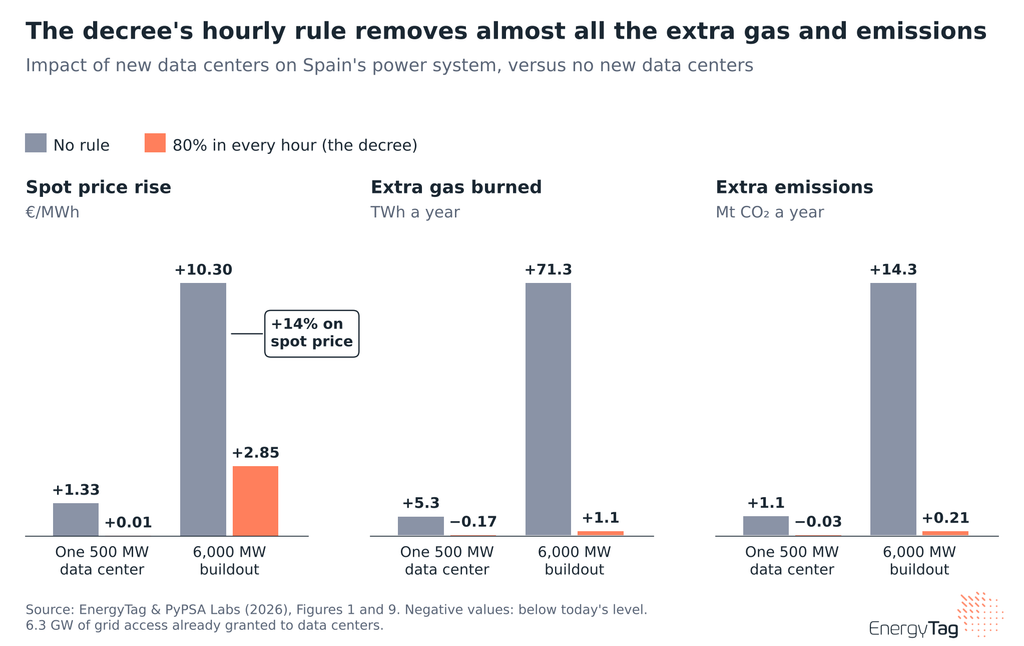
How to read it: grey bars show how much new data centers push up the wholesale (spot) electricity price with no rule. Orange bars show the rise with the decree’s 80% hourly rule. The three panels show the spot price, gas burned, and emissions
At full scale, no rule adds 10.30 €/MWh to the market price, a 14% increase. It also raises power-sector emissions by 81% and burns 71 terawatt hours (TWh) more gas a year. The decree’s 80% hour-by-hour rule removes 72% of the price rise and 98% of the extra gas burn and emissions compared to the no-rule scenario.
At €100/MWh for gas, consumers have more to lose
The model uses 2025 gas prices of 36 €/MWh. Europe’s TTF gas benchmark hit 100 €/MWh in late October.
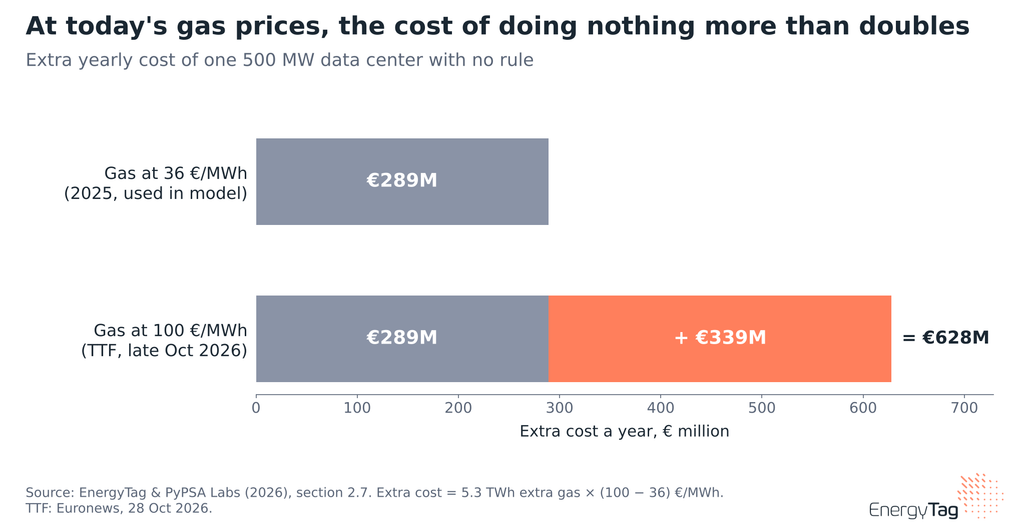
How to read it: both bars show the extra yearly cost of one 500 MW data center with no rule. Orange is the added cost at today’s gas price.
One 500 megawatt (MW) data center adds €289 million a year to fuel and running costs of Spain’s power system. With October 2026 gas prices, the cost of doing nothing more than doubles. The decree’s rule cuts the extra gas burned from 5.3 TWh to slightly below zero: an insurance against the next price spikes.
Spain’s decree is not a ban on data centers
Spain has now adopted an 80% hour-by-hour rule. No hour can dip below 80%, even on a still winter night, without triggering a compliance penalty. To guarantee that, one 500 MW data center needs 6.2 gigawatt-hours of batteries and contracts 41% more power than it uses. That adds €106 million a year to Spain’s power system costs versus no rule.
That is the right principle, and it should not be read as an effective ban on data centers. The final decree removes the specific procedure in Article 11 of the earlier drafts that could have seen a data center lose its grid access for repeated non-compliance.
For operating facilities, the rules now work differently. Operators pay cost-reflective compensation for non-compliance with the renewable requirements. Breaches of the efficiency and digital sovereignty requirements lead to corrective measures. If an operator does not fix a breach, sanctions apply under existing legislation.
Authorities can suspend or revoke permits only where a law provides for it.
A cheaper way to meet the same goal: score hourly matching with an annual average
The main opposition party in Spain, the People’s Party (PP), has stated they will revoke the decree if it wins the 29 November election. Our modeling shows that without a rule, the 6 GW buildout would add €2.6 billion a year to consumers’ bills, almost €1.9 billion more than under the decree. If their concern is that this bill is overly complex, our modeling shows a better way. A requirement that is based on an annual average hourly matching score rather than a fixed requirement in each hour. Because the score averages across all 8,760 hours of the year, the target could be set higher, at 90%.
Every hour still counts, but a windy night can make up for a still afternoon. That lets data centers lean more heavily on wind, which blows at night and in winter.
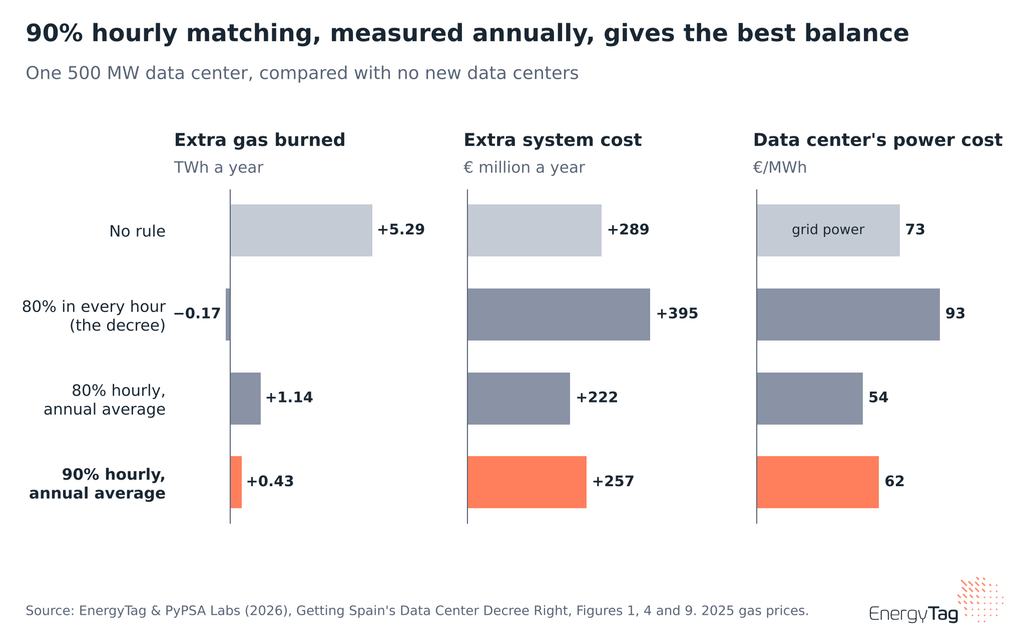
The result is almost the same protection for consumers at lower system cost. At 90%, emissions and gas burn fall 92% and the price rise falls 89% compared with no rule. The extra cost to Spain’s power system falls from €289 million to €257 million a year, and data centers pay 62 €/MWh, below the 73 €/MWh cost of grid power. Investment can go ahead while consumers are protected from steep price rises.
Spain can show Europe how to grow data centers without higher bills or deeper gas dependence. Read the full study or rerun the model on GitHub.
FAQ
Will new data centers raise electricity bills in Spain? Without a clean power rule, yes. Data centers run around the clock, so at night and in winter gas plants fill the gap and set the market price. Our modeling finds only one 500 MW data center would already raise the spot price by 1.33 €/MWh. Building out the 6 GW of data centers with grid access would raise it by 10.30 €/MWh, or 14%. 90% hourly matching removes 89% to 93% of those increases.
What is hourly matching? Hourly matching means buying clean power produced in the same hour as electricity use. Most corporate clean energy claims today use annual matching: buy as much renewable power over a year as you consume, regardless of when it was produced. That lets a data center run on gas power at night while claiming to be solar powered. Hourly matching closes that gap, so clean power is there when the servers need it.
Why measure the target as an annual average, not every hour? An every-hour floor means the hardest hours of the year drive the cost. In our modeling, 6.2 gigawatt-hours (GWh) of batteries are needed for one 500 MW data center. The last step from an 80% average to the every-hour floor costs around €660 per extra tonne of CO2 avoided, roughly nine times the EU carbon price. An annual average delivers nearly the same gas, price, and emissions benefits at far lower cost.
Does the rule stop data centers being built in Spain? It does not. Data centers can be built without complying with the decree requirements. Crucially, the final decree removes the possibility for a data center to lose its access and connection permits for repeated non-compliance. Instead, missing requirements lead to automatic non-compliance fees billed monthly by the network operator. These relatively modest figures are fixed based on the data center’s total consumption (Article 9).
- For additionality: €6 to €25/MWh, depending on the size of the shortfall below 80%.
- For hourly matching: €2 to €16/MWh, depending on the average monthly deviation.
Revenues will fund the capacity mechanism and other additional costs created for consumers.
Authorities can suspend or revoke permits only where a law provides for it.
How did you calculate the cost to consumers’ bills? Our model calculates how much new data centers raise Spain’s average spot electricity price. We multiplied that rise by Spain’s existing electricity demand of about 251 TWh a year, because every household and business pays the higher price on all the power it already uses. With no rule, the 6 GW of data centers that already hold grid access would raise the spot price by 10.30 €/MWh, adding about €2.6 billion a year to bills. Under the decree, the rise is 2.85 €/MWh, or about €0.7 billion a year. The difference, almost €2 billion a year, is what the decree keeps off consumers’ bills. For a 4 GW buildout, the same method gives about €2 billion a year with no rule.
Who did the study? EnergyTag and PyPSA Labs, two independent non-profits with no commercial interest in the outcome. The study received no external funding.