

How India’s Round-The-Clock Tenders Are Redefining Renewable Energy Procurement
Across the world, the conversation around clean electricity is changing. There is growing attention not just to how much renewable energy is produced, but when it is produced.
The IEA shows that to successfully integrate high levels of renewables, storage, and flexibility are crucial. Interest in discussions around time-based matching, often framed as hourly matching, is growing. Many stakeholders are simultaneously continuing to question whether such approaches are practical, particularly in Asia, citing concerns about limited clean energy procurement methods, data availability, complexity, and cost.
However, this debate is currently limited. Robust accounting frameworks are essential for ensuring credible corporate clean energy claims. But from a system perspective, the bigger challenge lies in how electricity markets are designed, whether they can incentivize clean power to be delivered when it is needed.
When considering market design, India is slowly becoming a leader in this space. Through its Round-the-Clock (RTC) renewable energy tenders, the country is already demonstrating how firm, reliable renewable power can be procured on scale.
The Key Challenge: When Renewable Energy Doesn’t Match Demand
The first phase of renewable energy growth was driven by a simple objective – to increase clean energy generation. Solar and wind capacity expanded rapidly, supported by long-term power purchase agreements focused on energy volumes.
However, as renewable penetration increased, a structural issue became more visible. Solar generation peaks during the day, while electricity demand often rises in the evening. Wind output varies across seasons and regions. These mismatches lead to familiar system challenges: curtailment during periods of excess supply, steep ramping requirements, and increasing balancing costs.
In India, this has created a “duck curve” in its generation profile. Solar-heavy midday supply is followed by sharp evening demand spikes, creating a widening gap between generation and need, and putting increasing pressure on the grid.
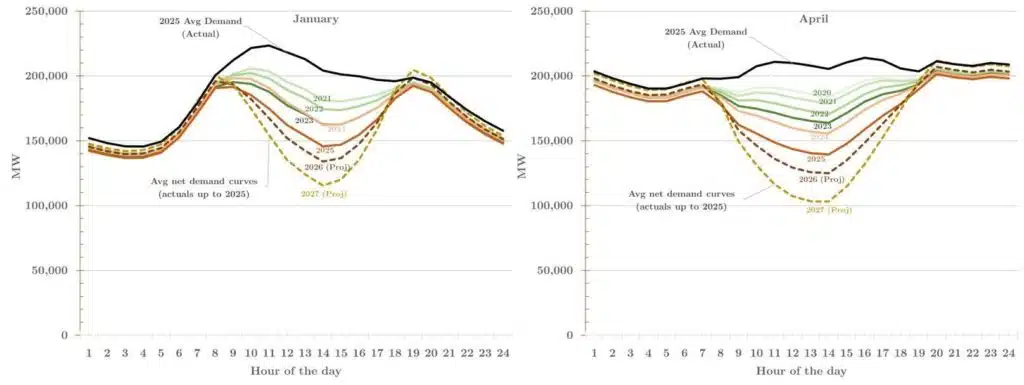
Figure 1: India’s deepening duck curve by Professor Nikit Abhyankar
This highlights the importance of considering when renewable energy is generated, rather than just how much is produced.
Early Response: Improving Supply, Not Reliability
One of the early responses to this challenge in India was the introduction of hybrid tenders, combining wind and solar generation. These projects improved the overall generation profile by spreading output across more hours of the day and year. They also helped increase the utilization of transmission infrastructure.
However, hybrid procurement did not fundamentally change the nature of the contract. It still focused on energy supply, without guaranteeing delivery at specific times or ensuring firm power availability.
This gap led to the emergence of a new, structural solution. Round-the-Clock (RTC) clean energy procurement, led by the Solar Energy Corporation of India (SECI), who act as the central implementing agency for designing and procuring renewable power through competitive tenders.
RTC Procurement: A Shift from Energy to Firm Power
RTC tenders represent a change in how renewable energy is procured.
Instead of buying renewable electricity when it’s produced in energy terms (MWh), RTC tenders procure power in capacity terms (MW), with an obligation to supply that power consistently across all hours of the day.
This fundamentally changes the role of the developer. Rather than operating a single-generation asset, developers must design projects capable of meeting round-the-clock supply obligations. This typically requires a combination of renewable generation and energy storage, even though the exact configuration is left to the developer. They are also responsible for scheduling power, meeting supply commitments, and managing variability.
In effect, RTC procurement transforms renewable energy contracts from generation-based agreements into performance-based supply obligations.
Evolution of RTC Tenders in India
India’s RTC tenders have evolved significantly over time, reflecting a gradual tightening of performance expectations.
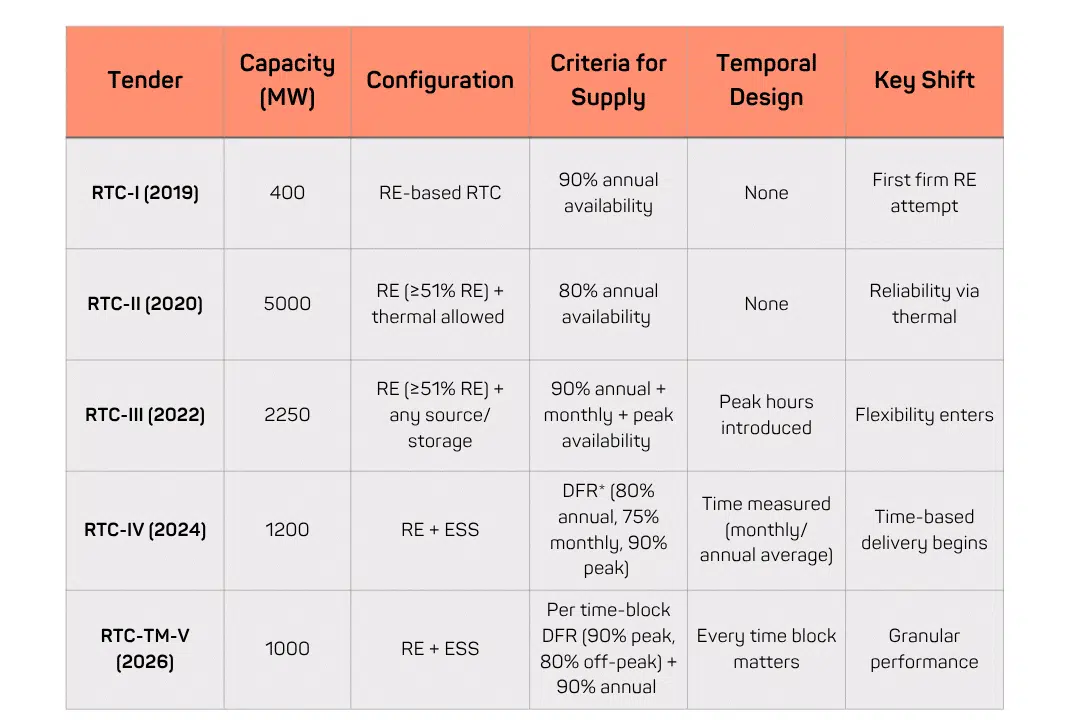
*The most important transition came with the introduction of the Demand Fulfilment Ratio (DFR), which shifted performance assessment from simple availability to actual scheduled delivery. In doing so, RTC tenders began to link renewable energy supply with when power is delivered, not just how much is generated.
DFR = Scheduled Power Injection (MW) / Contracted Capacity (MW)
In the early tenders, the focus was on ensuring supply reliability, often supported by thermal power. Over time, the design shifted toward enabling clean flexibility through storage and hybrid systems. More recent tenders have further refined this approach by incorporating time-specific requirements, gradually tightening expectations around delivery during critical periods.
Deep Dive: Recent RTC Tenders
India’s recent RTC tenders reflect a clear step change from the initial versions. At the centre of both RTC-IV and RTC-TM-V is the Demand Fulfillment Ratio (DFR) calculated at each time block as the ratio of scheduled power to contracted capacity. While the definition remains unchanged, the way it is applied fundamentally alters how renewable power must be delivered.
SECI’s RTC-IV marked a significant step in this direction by introducing DFR-based performance along with peak-hour requirements. Building on earlier tenders that introduced time-based signals, it formalized the shift from availability to delivery. However, performance was still measured through averages across time – monthly, annual, and peak-hour averages, allowing developers to balance supply across different hours.
The next step, RTC-TM-V, removes this flexibility. Instead of averaging performance, it requires developers to meet DFR in each time block, with peak hours defined dynamically on a day-ahead basis. This shifts the obligation from managing performance over time to delivering power precisely when required.
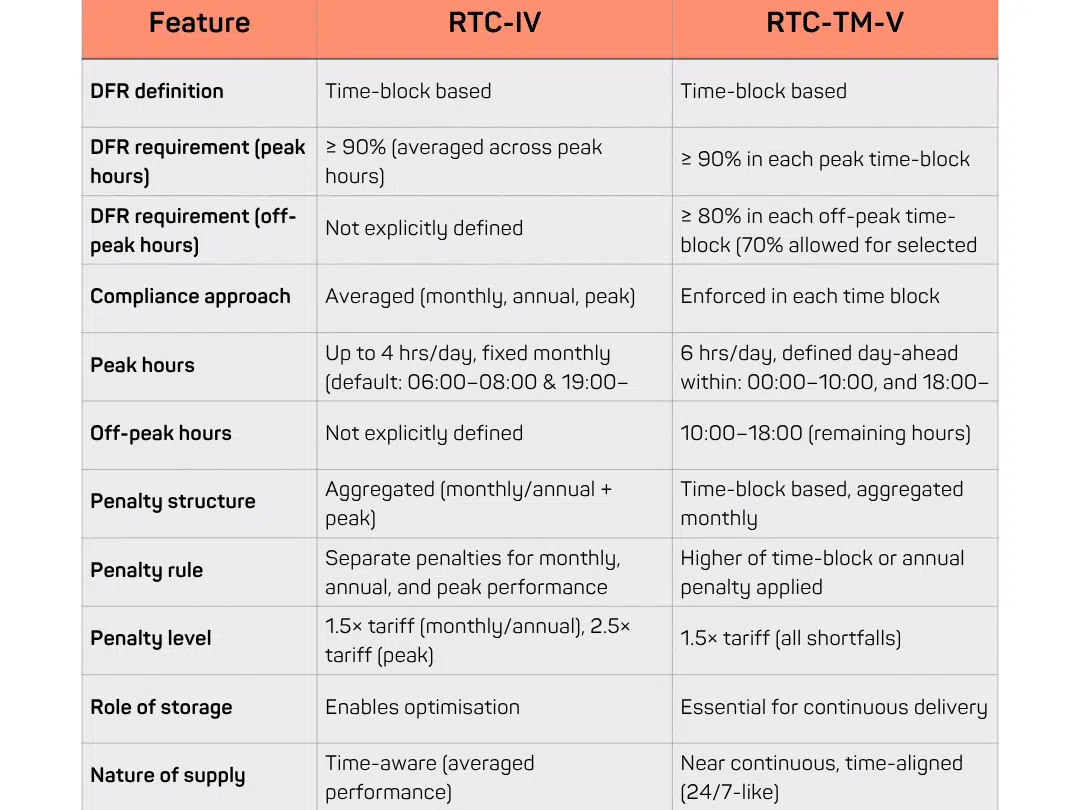
Under RTC-TM-V, penalties are calculated for each time block, with no ability to offset shortfalls through over-supply in other periods. This makes every hour a point of accountability and enforces consistent delivery across the day, bringing renewable procurement closer to true round-the-clock power.
From Design to Market Reality: Evidence from RTC Tenders
The success of any procurement design will always be dependent on how the market responds to these new rules.
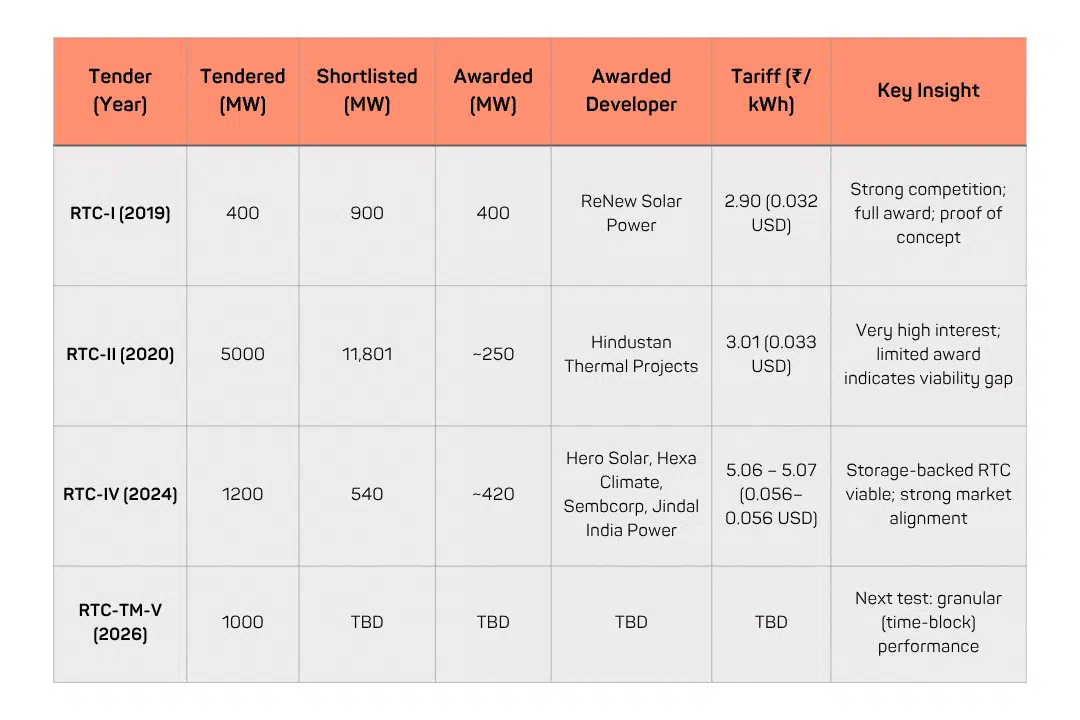
USD values are indicative, calculated using an exchange rate of ₹1 = $0.011 (as of 27 April), and rounded for simplicity.
Global benchmarks for firm renewable power, combining generation and storage, typically fall in the range of $0.05–$0.10/kWh (BloombergNEF). India’s RTC-IV tariffs, at ~$0.056/kWh, sit at the lower end of this range, indicating that time-aligned, storage-backed renewable supply is already being delivered competitively in the Indian market.
What RTC is Changing
The impact of RTC tenders extends beyond procurement:
- Energy storage becomes central to project design and economics.
- Demand-side flexibility gains value, as time-based signals emerge.
- Markets begin to move toward real-time operation, with greater emphasis on scheduling and dispatch.
- Renewable energy is no longer treated as a variable supply, but as a resource capable of delivering firm, dispatchable power.
The Future of Renewable Procurement
The evolution of renewable energy procurement in India reflects a deeper transition. It is no longer sufficient to measure success in terms of installed capacity or energy generated. The focus is shifting toward how effectively renewable energy can support the power system, reliably, consistently, and at the right time.
India’s RTC tenders provide a practical example of this shift in action. They show that with the right market design, renewable energy can move beyond variability and begin to take on the role traditionally played by conventional power.
The next challenge for the clean energy transition revolves around delivering clean power when it matters most, not just increasing capacity.